


BOZEMAN — About 38 of Montana’s 56 counties face some level of healthcare workforce shortage, according to the state’s Department of Public Health and Human Services. With an insufficient number of medical providers, primarily in rural counties, comes higher rates of chronic disease, diabetes and child mortality compared to national averages.
“Being shorthanded in healthcare is never a good thing,” said DeeDee Dalke, Allied Health director at Gallatin College Montana State University. “We want safe, good quality patient care.”
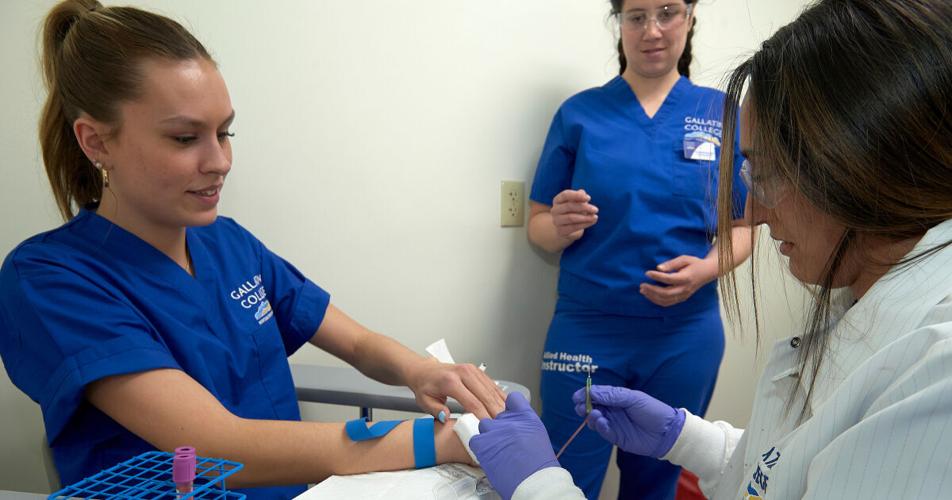
As part of Gallatin College MSU’s effort to bolster the medical workforce in Montana, 13 phlebotomy and medical assistant students are learning the ins and outs of patient care this summer. They will complete more than 100 hours in phlebotomy, urology, urgent care and rheumatology units at the Bozeman Health Deaconess Regional Medical Center and its Belgrade clinic, one of several hospitals and clinics collaborating with Gallatin College MSU across Montana and the nation.
People are also reading…
During Nicole Lamphier’s first three weeks of medical assistant training, she conducted throat swabs, blood draws, wound irrigation and medicine injection. Many were during her first day on the job, when she helped treat 55 patients during a fast-paced, nine-and-a-half-hour shift.
“I know what it's like to need care on your worst days,” she said. “And I want to be that person for someone else.”
Lamphier, who is from Sidney and has lived in Bozeman since 2012, adjusted to several life changes this year. She turned 40, went through a divorce and transitioned from a stay-at-home parent to a financial provider for her two children. Amid these changes, Lamphier said she was touched by the care she received from local medical staff, and she decided it was time to go back to school 19 years after she started a four-year degree at MSU.
She studied and did housework until 2 a.m. some days, waking up four hours later to take her children to school. It was “sink or swim,” Lamphier said, but Gallatin College MSU faculty and staff were the buoys keeping her afloat. They lent a listening ear and pointed her toward the federal Pell Grant to fund her yearlong certificate, and she discovered just how much she could excel in class. Lamphier earned top grades and a newfound confidence that served her well during her 160-hour externship, which is her final step before earning her college certificate.
When a doctor asked her team to bandage a laceration using a metal tube, Lamphier was the only person who knew the technique, having recently studied it in class. Just three weeks into her externship, her supervisor encouraged her to apply for a full-time position at Bozeman Health before she completes her training in August.
About 85% of students each year are hired at the end of their externship, Dalke said. They are joining a growing healthcare sector in Montana, which is projected to add 980 jobs per year through 2034, according to the Montana Department of Labor and Industry. About half of these job openings will require certification or a college degree.
Lamphier plans to use her certificate as a stepping stone. After gaining experience in the workforce, she’ll apply for nursing school at MSU with a goal of becoming a travel nurse.
“It feels great, that security and knowing my skills are strong enough to be hired,” she said.
Hannah Johnson, a 27-year-old phlebotomist from Bozeman, hopes to work for Bozeman Health after completing her two-week externship and taking a professional certification exam.
“If you would have told 16-year-old me that I was going to one day professionally be poking people and drawing their blood, I would have been like, ‘You are crazy,’” she said.
Johnson had a healthy fear of needles growing up, one that faded as she spent more and more time as a hospital patient during her freshman year at MSU. She had numerous kidney infections that year and had to medically withdraw from college.
She spent several years as a caretaker, but she said she was itching to find a new learning opportunity that challenged her and allowed her to support patients through difficult times. Johnson continued caretaking while pursuing Gallatin College MSU’s semester-long phlebotomy program, where she drew blood from mannikin arms before advancing to human patients.
During her externship, Johnson completed 100 “pokes” and 100 hours of blood draws and lab work for a variety of patients. One, a woman who had fragile veins after years of chemotherapy, was impressed that Johnson needed only two pokes before drawing blood. Previous phlebotomists had to use a sonogram to find her veins. Another, a teenager who required 12 tubes of blood drawn, squeezed Johnson’s arm for comfort while Johnson balanced vials in order with her other hand, which is vital to making sure a patient’s bloodwork is read correctly.
Working with patients was less daunting than deciding to pursue a college certificate, Johnson said. But this leap of faith paid off — phlebotomists are high in demand and typically earn $36,190 to $54,700 on average in Montana.
“It makes me feel like a proud parent,” Dalke said. “Because now these students are finishing the summer, and they're going to go off and do great things.”


