


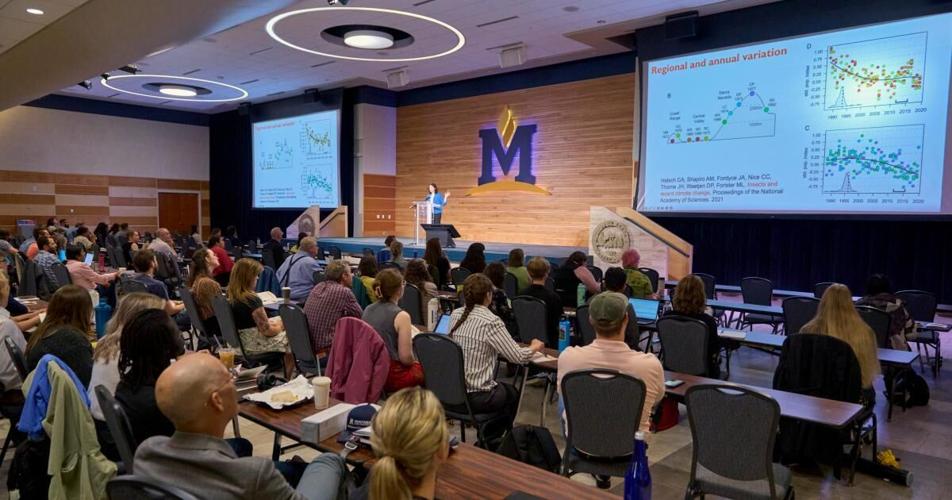

BOZEMAN - Researchers from around the world gathered at Montana State University June 25-27 for the International Conference on Pollinator Biology, Health and Policy, exchanging research and ideas on pollinator health, natural history and land management.
The three-day event, organized by Michelle Flenniken, a professor in the College of Agriculture’s plant sciences and plant pathology department, and Christina Grozinger from Pennsylvania State University, welcomed scientists representing universities, government agencies, industry and nonprofit organizations. Together, participants covered topics including the impacts of pathogens, pesticides and climate on bee health and floral resources, as well as habitat restoration and land management.
The conference provided an opportunity to share research that is important for Montana’s economy and environment, according to Flenniken, who noted that Montana is an important beekeeping state, often ranking in the top five U.S. states for honey production. She added that Montana’s commercial beekeepers provide approximately 300,000 honeybee colonies for pollination services annually.
People are also reading…
In 2023, Flenniken served as co-director of the last conference held at Penn State. She is the co-director of MSU’s Pollinator Health Center and serves as a science adviser for Project Apis m., a nonprofit organization that funds research aimed at addressing the challenges faced by commercial beekeepers – including average annual colony population losses of around 38% since 2008. Research in Flenniken’s lab focuses on understanding the impacts of viruses on honeybees at the colony, individual and cellular levels.
Grozinger, director of the Huck Institutes of the Life Sciences at Penn State, delivered the opening presentation, “Leveraging Technology for Pollinator Management and Conservation.” Drawing on research from her lab, she highlighted how emerging technologies can support pollinator research and encouraged attendees to pursue "new ideas and new collaborations," reminding the audience that while "challenges are global, solutions can be local."
Naomi Kaku, who recently earned a doctorate in plant sciences and plant pathology from MSU, described how virus infections can affect honeybee flight performance and what those changes may reveal about honeybee health. Hunter Charles, a current MSU doctoral student, presented research examining how compounds including thyme oil and thymol – at low concentrations similar to those produced by thyme plants – can stimulate honeybee antiviral defense pathways that help reduce deformed wing virus levels.
Montana is also home to many native and wild bee and butterfly species. MSU ecology professor Laura Burkle described environmental drivers of bee community composition in Yellowstone National Park. Diane Debinski, formerly head of MSU’s Department of Ecology, described declines and variation in butterfly species composition in Glacier National Park. Debinski discussed how butterflies can serve as ecological indicators because they are sensitive to changes in climate, helping researchers better understand changes in biodiversity over time.
"It's exciting that MSU has the capacity to study pollinators from so many different perspectives," Debinski said. "Having researchers come from across the country and around the world to discuss pollinator health really puts MSU on the map."
The conference also featured a poster session supported by MSU’s Office of Research and Economic Development. The event enabled attendees to connect with fellow researchers and learn more about studies being conducted across a wide range of pollinator-related topics.


