


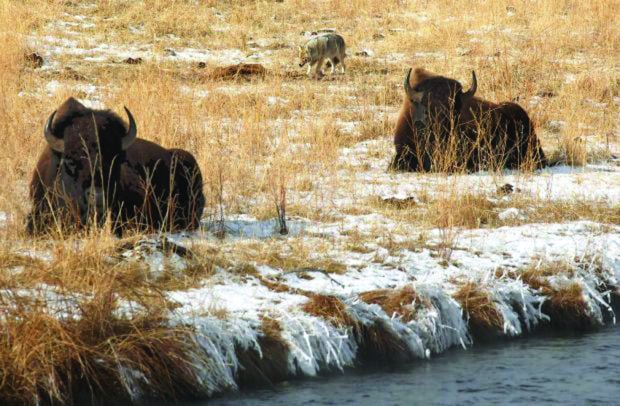
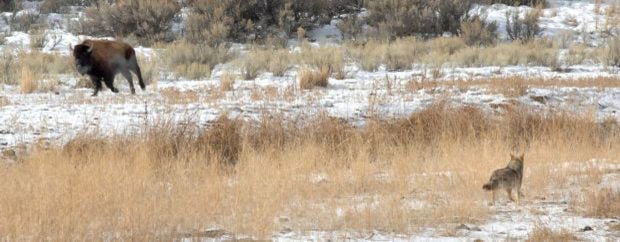
The coyote was a little nervous about its proximity to the roadway, but with winter’s frozen grip firmly clasping Yellowstone National Park, the canine was willing to take the risk to dine on the picked-over remains of an elk carcass just across the Gardner River.
The juxtaposition of the coyote dining on an elk behind two large bull bison provided an unusual photo opportunity, so I pulled my vehicle into a nearby turnout and slowly walked closer, camera in hand.
Bison have been in the news recently, and not in a good way. Yellowstone officials began shipping animals that have migrated to its northern border to American Indian tribes. The herd reduction is required for the park to meet the terms of an agreement with the state of Montana. Yellowstone plans to remove 300 to 600 bison this year, if possible.
The Yellowstone bison are the descendants of a small group that hid in the park’s interior, avoiding eradication that removed the majority of their brethren in the 1800s. By 1902, most of the estimated 30 to 60 million bison that had roamed North America had been eliminated by market hunters, sport hunting and the U.S. Army. Less than two dozen survived within Yellowstone.
People are also reading…
This summer, their numbers within the park were estimated at 4,600. Their recovery is considered a conservation success story. Although the animals are both hated and loved, there’s no arguing that they are an impressive species well-adapted to
their environment.
Bulls can weigh up to 2,000 pounds while females can grow to 1,000 pounds. Despite their size and docile looks, the animals can accelerate quickly and can hit speeds of 30 mph for a short distance — hence the park’s regulation that people stay at least
25 yards away.
An old bison may be 12 to 15 years old, and has few predators once fully grown. Wolves and grizzly bears are more likely to attack young bison, although herds can be fiercely protective of their young, encircling them to persuade predators a calf meal isn’t worth the risk.
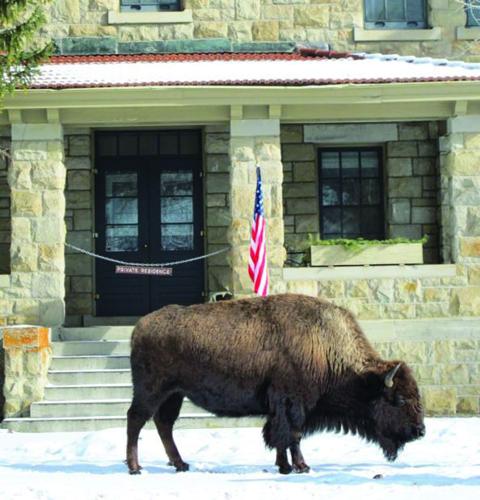
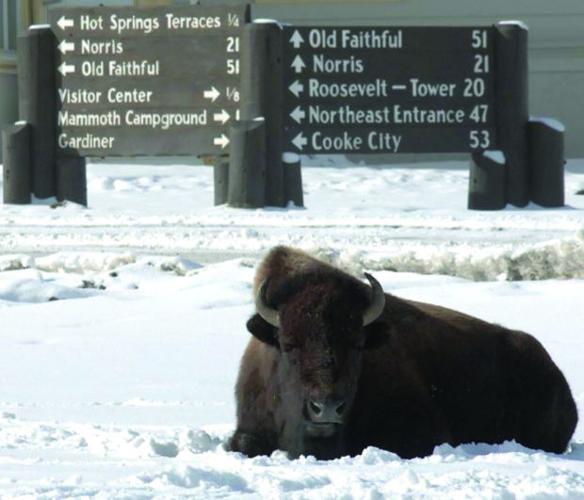
Because bison are so commonly seen in the Mammoth Hot Springs area of the park, they provide a variety of photo opportunities for visitors in winter. The hard part is to find and compose a photo that is different, like the coyote and the bulls. But such setups don’t last long.
When another group of bison came pouring over a nearby hill at a dead run — like something out of a Western movie — the lone coyote spooked and ran in the opposite direction. The unique photographic moment had disappeared. I didn’t mind, though. It was cold. I needed to warm my numb fingers.


