
Partners raise the bar on specialized practice
Story by Paula J. Peters for inBusiness
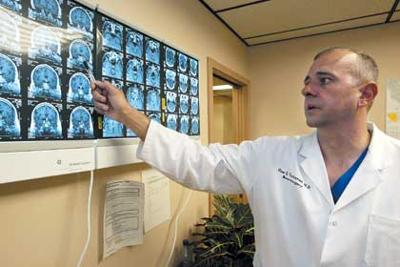
Dr. Peter Sorini sits in his Butte office, just a stone's throw away from St. James Healthcare, the hospital in which he performs neurosurgery. "I grew up here and I could see that hospital every day of my life, never envisioning that some day I would work in it," he said.
Growing up in Butte, Sorini developed a strong sense of community and family, and that ultimately led him to set up a practice in the city of his birth four years ago.
"That was one of the draws for me. My mother and my sister, relatives and friends are here," he said.
Sorini did his undergraduate work at Marquette University in Wisconsin and went on to Marquette Medical School. Starting out in general surgery, Sorini's interest and talent ultimately led him to neurosurgery. He began his training at the Barrow Neurological Institute in Phoenix, Ariz., going on to finish at the State University of New York, at Buffalo.
People are also reading…
"From there, I did about two years of research in a spine lab, doing mostly biomechanical testing," Sorini said. "I finished my training in 1994, and went to Detroit for one year to work with my older brother, who is a physician," he said.
From Detroit, Sorini moved to Kalispell, and spent four years in practice there, before returning to Butte in 1998.
"I've always loved the town, but I never thought I'd really practice here," he said.
Sorini's decision to return to Butte has been good for the community in many ways. In addition to improving the level of patient care available in the area, the practice has also created four full-time and five part-time jobs.
Sorini hasn't regretted his decision to come home. He cites the people in the Southwest Montana as a prime reason.
"The people are great. That's the best reason to practice here," he said.
Sorini said that practicing in a close knit community is very different from practicing in a larger city.
"It changes how you approach things," he said, referring to the increased level of personal involvement with each case.
Sorini's decision to come to Butte was based on more than personal ties to the city. He said he saw the potential for continued growth in the area. His hunch was right. Since opening his practice, Sorini has been busy. So busy, that he recently took on a new partner in practice, friend and fellow neurosurgeon, Dr. Gus Varnavas.
Varnavas, who has spent more than 20 years in the U.S. Air Force, attended medical school at Uniform Services University of the Health Sciences in Bethesda, Maryland. From there, he went on to intern at Wilford Hall, the USAF Medical Center in San Antonio, Texas.
"After that, I was selected by the military to go train in neurosurgery at the State University of New York at Buffalo. That's where I met Pete. We were there together for four or five years," he said.
The two became fast friends and hoped to practice together some day. In May of this year, after Varnavas chose to leave the service, he entered into civilian practice with Sorini in Butte.
Varnavas brought some unique skills with him to the practice. While at SUNY, he had completed a skull-base fellowship, with the emphasis on vascular surgery, intracranial endoscopy, and anatomical research. "I trained for a while in Europe after completion of my fellowship," Varnavas added, explaining that the techniques he learned while in studying in Germany employed minimally invasive approaches to intracranial surgery.
Varnavas described intracranial endoscopy as part of a surgical philosophy called "keyhole surgery."
"It's much less invasive and better tolerated. There's less recovery. It's not as disfiguring in many cases. It's not appropriate for
Neuroscience …
Continued from Page 6
everybody, but in the right patients, it's really nice," he said.
Varnavas' skull base fellowship provided good balance to Sorini's spine based training, offering patients a wider complement of neurosurgical skills at the practice.
Varnavas is pleased with his decision to join Sorini in practice in Butte. "This is a nice town. I didn't want to raise my kids in a big city," he said.
"This might sound corny, but I feel useful. I actually think we're needed here," he said. Varnavas is also enthusiastic about future plans for the expansion of Big Sky Neuroscience and Spine.
"There's a huge opportunity here. It's exciting because we have the opportunity to build a regional neuroscience center," he said.
According to Sorini, that is precisely what he has envisioned since opening the practice in Butte. Having Varnavas join him, was just another step toward realizing that goal.
When Sorini first began practicing, he kept his focus on the broad scope neurosurgery. He routinely handled cases involving brain tumors, aneurysms, spine abnormalities, degenerative conditions and trauma in and around the Butte area.
As his reputation as a surgeon grew, so did his practice - along with the need for expansion.
"Fifty-three percent of the patients in our practice come from outside of Silver Bow County," said Sorini, who is tailoring the business end of his practice to meet the current needs of patients in the area in a variety of ways.
In addition to addressing the increased caseload by taking on a new partner, Big Sky Neuroscience works to provide patients in the area with easy access to specialists from outside the region as a means to supplement their treatment.
"We offer pain management with Dr. Steve Martini and we offer rehabilitative services with Dr. John Stephens," said Sorini. He explained that Martini and Stephens each come to Butte from Kalispell one week out of every month. Locally, the practice also routinely refers patients to Dr. Harold Bolnick of St. James Healthcare's Pain Center for assistance with pain management.
Big Sky Neuroscience is also currently expanding into various other communities in the region. The practice has opened and operates a satellite clinic in Helena, and a second clinic opened in Bozeman on September 6. A third satellite clinic is currently being proposed, with plans to open in Dillon as early as October.
Big Sky Neuroscience's Business Administrator, Barb Cook, explained the reasoning behind the decision to branch out into southwest Montana. "We had so many patients coming from those areas that we thought it would provide more convenient and accessible patient care," she said.
Cook also said that Big Sky Neuroscience was currently working with endocrinologist, Dr. Jose DeSouza, on plans for the development of the Southwest Montana Skull Base and Pituitary Center. The center would unite both the surgical and endocrine expertise of the three physicians to better serve area patients with related concerns.
The practice is also recruiting a third partner, as part of a plan to diversify their practice in a novel way.
"We want to interject some real science back into the practice," said Sorini.
Big Sky Neuroscience, he said, is exploring the possibilities of doing some collaborative work with Montana Tech and Montana State University involving biomechanical testing, product and design testing, and research.
The two practitioners are excited about the potential for growth in this area of the practice.
"The collaboration is good for the universities," said Varnavas. "It's good for the hospital. It's good for us. Ultimately, the people who benefit the most from it, are the patients." v