


Buds on crab apple and apple trees are swelling and flowers will soon appear. Homeowners having problems last year with fire blight in their apple trees should prepare to treat them, as treatments are done during the blooming period.
Fire blight is a bacterial disease of plants in the rose family, but primarily of apple trees in this area.
The bacterium causing fire blight, ewinia amylovora, overwinters in cankers on limbs.
During wet, warm weather in the spring the bacteria multiply and the cankers become sticky. The bacteria are then carried to the flowers by wind, rain, and particularly by insects. The bacteria gain access to the tree's vascular system through the flowers and once into the system can travel throughout the tree. Untreated fire blight will seriously affect some varieties of apple trees and can kill others.
People are also reading…
No apple tree is entirely immune to fire blight but some cultivars are resistant to varying degrees. Homeowners contemplating purchasing apple trees should look for those designated as "resistant to fire blight."
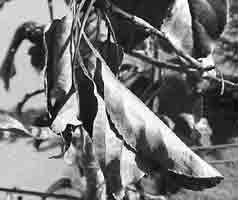
"Resistant" doesn't mean that fire blight will absolutely never infect a tree so designated; it does mean that the effects of fire blight will be less invasive and likely to progress at a slower rate. Fire blight is easily recognized. The first symptom is a wet looking flower. The bacteria then move to leaves. The photo above right shows leaves with a fiery look and the leaf petioles are black as if burned. When symptoms appear homeowners should take preventive measures.
Remove twigs and limbs several inches below the infected area using pruning tools disinfected between cuts with a 10 percent solution of bleach and water. The disinfectant prevents transferring bacteria from one part of the tree to another. The surest remedy for fire blight is streptomycin, an antibiotic sold as (Agri-Strep). Apply the first application soon after the first blooms appear, a second application when half of the blooms appear, and a third application during full bloom.
Diligent pruning of infected limbs in combination with timely applications of Agri-Strep will control fire blight sufficiently so that crab apple trees will continue to bloom magnificently every year and apple trees will continue to produce apples.
— Harold Johns is the Butte-Silver Bow County extension agent. His office is in Room 302 of the Business Development Center, 305 W. Mercury; telephone 723-0217, or cell phone, 490-7408. The email address is BSBEXTN@IN-TCH.COM; the Web site is www.bsbextn.org.


