


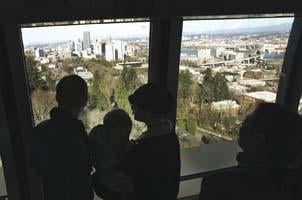
PORTLAND, Ore. — With a gentle lift, Portland’s new aerial tram slips out of its bay, dips at the first tower, and whisks surgeons, patients, cooks and the curious up ‘‘Pill Hill’’ to the Oregon Health and Sciences University, Portland’s biggest employer and Oregon’s medical school.
A group of children let out a collective ‘‘Wheee!’’ when the tram dipped during its 3,300-foot journey over people’s homes.
‘‘We had read about it, and we were in town and figured, ‘Why not,’ said Vera Molina, who lives near Salem and brought two young sons to ride the tram a few days after it opened to the public.
The tram cost nearly four times the approved estimate to build. And the $4 fare is more than double what had been originally proposed. But it’s a breathtaking ride, one sure to draw more attention to this city on the banks of the Willamette River.
People are also reading…
On clear days, which some here aren’t, tram riders get a postcard view of Portland, across the Willamette to Mount Hood and north to what remains of Mount St. Helens, which famously blew its top in 1980.
The tram was built as part of a plan to develop the South Waterfront, an underused, frowsy stretch along the Willamette River where the tram begins and which is drawing some $2 billion in private investment and from OHSU, which had run out of room on the hill and is expanding down on the waterfront.
But Portland officials also see the tram as yet another way to move people around, in a city already known for its impressive array of alternative forms of transportation, including streetcars, a light rail system and miles of bike paths.
Portland’s greater metro area has grown by a third — to about 1.55 million residents — since 1980, and the city’s still growing.
The new tram can be reached by streetcar, a system many cities including Portland, had scrapped by the 1950s. In 2001 Portland brought them back, and there are plans for expansion.
The streetcars connect to bus lines which connect to the expanding MAX light rail system, which echoes the interurban trolley network that brought workers from outlying areas to the city to keep it vibrant a century ago.
More bicycle paths are being built on streets and bridges where motorists and bike commuters mingle in rush hour, sometimes with mixed affections.
Developers say the tram will reduce driving by 2 million miles a year, saving 93,000 gallons of gas by tram riders who forgo the twisty road up to the hospital.
It is the second commuter-service aerial tram in the United States. The first, built in the 1970s, connects Manhattan with Roosevelt Island, a residential and small business development in New York City’s East River.
Steve Polzin, who directs transportation research at the University of South Florida’s Center for Transportation Research in Tampa, said a tram such as Portland’s can work in the right circumstances.
‘‘It’s a niche tool for a unique application, and it sounds like that’s the application out there,’’ he said.
He said in addition to moving employees, there is the ‘‘transportainment feature’’ in which paying tourists help sustain the system when the novelty wears off for local residents.
‘‘The origin-destination pairing is strong,’’ he said, ‘‘and typically you don’t need a lot of right of way for these things.’’
The city of Portland owns the tram, but OHSU operates it and paid 85 percent of the $57 million construction cost. The city’s share came from sale of bonds to be repaid by increased property taxes on South Waterfront property.
The tram had been ferrying hospital employees and patients since mid-December, and opened to the general public in late January.
On the weekend before it entered regular service, fares were waived and an estimated 10,000 riders tried it out.
Plans had been to match the fare with that of a bus ticket, $1.70, but it was later pegged at $4. Patients and employees of OHSU, VA Hospital patients and holders of monthly transit passes ride free.


