There are 61 species in the sandpiper family that frequent the
wetlands and wade marshes, mud flats or shorelines in search of
food throughout our continent.
Birds in this family are called shorebirds. Then, one might ask,
why is it that the largest of our North American shorebirds can be
observed during the spring and summer months in the semi-arid
foothills of southwestern Montana.
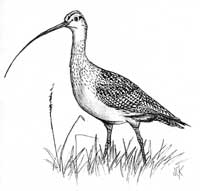
The long-billed curlew is a wonderfully odd looking bird that
migrates to Montana and other Great Plain States from the coastal
regions to breed in grassy wide open spaces or prairies far from
anything that resembles a wetland.
The curlew's long bill is between five and eight inches in
length and it curves significantly downward. Like many of the other
sandpipers, its wings are pointed and designed for speed. The
curlew's body is mottled with black and its underparts are tan.
Cinnamon underwing linings identify this species while in
flight.
Deriving part of its name from a repeatedly ascending cur-lee
call, the long-billed curlew was once much more widely distributed,
especially back East. Agricultural development and past hunting
practices has restricted or even eliminated this bird from much of
it historic range.
Nests are built in open grasslands where the curlew's coloration
allows it to bend well into the environment. Stretching its neck to
the ground while tending the eggs, this bird becomes virtually
impossible to see. Prairie insects like grasshoppers and
caterpillars sustain the curlew until it can return to the wetlands
and coastal regions where food is often more abundant.
With its long decurved bill, the curlew appears to be quite
awkward and particularly out of place while standing in the vast
open space of our foothills and grasslands. The long-billed curlew
has endeared itself, however, to many folks over the years because
it is a unique visitor to our region that the hearty Montana can
truly appreciate.