


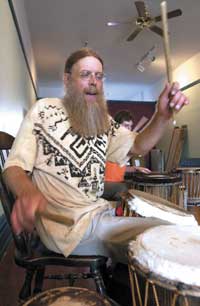
The rhythm of the djembe has a way of returning drummers to their most fundamental natures.
As vibrations from the goblet-shaped drum pulse through the bloodstream, the strains of contemporary living are pushed out.
"It's a primal experience," said Gandalf Bock, who teaches a West African drumming class Wednesdays at Sacred Ground in Uptown Butte. "Everyone has some level of relating to it."
Bock, who manages Len Waters Music Center in Butte, has studied with West African drum masters YaYa Diallo and Madou Dembele. His eight-inch beard framed a kindly smile when he encouraged his students.
The class participants represented a diverse group one recent evening.
To Bock's left sat Mike McNamee, a 15-year-old who got his driver's license a mere two weeks earlier. He loves punk rock and plays guitar in a garage band with no name. McNamee struck the barrel-shaped djun-djun drum with a faintly worried look on his face. McNamee took the class to develop his rhythm so he can improve his guitar playing.
People are also reading…
"It really has helped," he said. "It's therapeutic."
Next in the circle, Kathy Miller, 44, held the djembe drum she made. She looked like an earth mother.
"It's a wonderful way to express yourself," Miller, a geophysicist, said of the drumming.
With a look of concentration on her face, Heather Dougherty, a
29-year-old in jean shorts, competed the circle. She, too, played on a drum she made at a class Bock offered on drum building. Bock made the seven other drums in the circle.
Each member of the group played a different part to form the rhythm. The song is played like a round. Players rotate through the parts.
"It's all about community connection and playing together," Bock said. "It's so communal. You don't have the song without a certain number of people playing parts."
In the United States, the djembe has grown in popularity since the 1950s, when the tours of Les Ballets Africains introduced the instrument. In recent years, corporations like Toyota have added drum circles to enhance team-building, and drum circles have sprung up in Montana cities and towns.
"Drumming is catching on," Bock said. "I can see its value in team-building. Its essence is cooperation. You have to pay attention to what you're doing and also what everyone else is doing."
There isn't anyone who can't play the drums, Bock said. His class, which usually numbers about six, began playing this spring.
"The class is still in a place where it's pretty open to beginners," Bock said.
For now the class is learning six rhythms, each with three or four parts. In the West African country of Guinea there are more than
300 rhythms, some with as many as 20 parts.
"Even the master drummers can only claim mastery of 70 or
80 rhythms," Bock said.
"The thing that's so cool is that it is both polyrhythmic and polymetric," Bock said. "It's part of what gives African music its special quality."
To make a song, many different rhythms are played at the same time and some parts are played in more than one time signature. The songs all have different meanings. Some are prayer songs, some work songs and others are traveling songs announcing friendly intentions when traveling.
"We try to talk about that so we know more than the rhythm, so we know the meaning behind it," Bock said. "All the rhythms have a purpose and meaning in how they fit into life."
Traditionally most rhythms are sacred, like a prayer, Bock said.
"We aren't able to employ it the same way, but it's still important," he said. "It gets the fundamentals of music into your bones in a simple, but deep way."
Some elements of the spiritual side of West African drumming have survived the transition in the American culture, Bock said.
"For me, I have to play," he said. "It's almost like my second
religion."
In Africa, the drums have the additional benefit of scaring off lions and tigers.
"I can tell you from living in Alaska that it works for bears, too," Bock said. "They hate the sound of it."
In addition to the weekly drum class, Bock has started up a drum circle in Butte. The circle meets Fridays at 9 p.m. at Sacred Ground. The circle uses rhythms learned in the class and improvisation.
The circle is completely open. Those who don't want to drum can play other instruments or sing and dance. The group has a basket of instruments, wood blocks among them. Bock said he welcomes anyone to pick one up and jam along.
"People lose themselves to the circle," Bock said. "It's a good outlet for people to be able to improvise and play from the heart."


