


PHILIPSBURG — Shirley Beck has a theory that people only end up in Philipsburg for one of three reasons.
They have somehow heard of the town. They enjoy taking the road less traveled through life. Or they're lost.
‘‘You can't just be passing through and end up in Philipsburg,'' said Beck, who
co-owns six commercial buildings along the historic mining town's Main Street. ‘‘We love adventurous people.''
And tourists do make the trip, westward through Anaconda, past Georgetown Lake and Discovery Basin along Montana Highway 1. The tiny town tucked on a gently sloping hillside surrounded by green ranch land and brilliant mountain views attracts visitors fome from all over the world, Beck said, to wander the three short blocks that make up Broadway.
They dig into Philipsburg's rich history at the Granite County Museum and Cultural Center, watch live dramatic performances at the Opera House Theatre and do a little mining of their own at Beck's Sapphire Gallery. Some tourists, like Jane Copsey of Missouri, return time and time again for the simple joy of gem hunting.
People are also reading…
‘‘It's interesting,'' Copsey said, using tweezers to search for sapphires in a pile of rocks in the mining room of the Sapphire Gallery. ‘‘You can find all kinds of rocks. We're big rock hounds.''
For $25, tourists are given a bag of rocks that's guaranteed to contain at least one gem-quality sapphire.
‘‘It brings out the pirate in all of us,'' Beck said. ‘‘People enjoy finding something of their own that no one has seen before.''
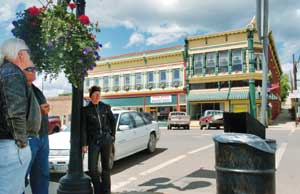
With its bright facades and sidewalks bustling with pedestrians, Philipsburg has found itself thriving in a modern world after years of struggling for survival. Many of the buildings put up in the late 1800s have been recently restored, each with its own colorful paint job reflecting the owners' individual spirits. Fancy light poles and hanging flower baskets now line the streets.
‘‘You look at it and it's beautiful,'' said Jody Cutler, 30, a Philipsburg native who returned to Granite County with her husband recently to raise her family. ‘‘It has changed and it hasn't. It's still home.''
Beck moved to Philipsburg in 1979 to manage the local sapphire mine — one of many mines in Philipsburg's history. The town was founded on a silver rush in 1867, brought back to life with a manganese boom during World War I, and has existed mostly on its extractive industries through the years.
The population, that at its peak was several thousand, dropped to about
900 people, where it remains.
‘‘Eight businesses closed on the main street in 1991,'' Beck said. ‘‘Two hardware stores can't make it in a town with that few people. We lost a clothing store that year, a restaurant.''
So she and her business partner Dale Siegford decided to create a little
economic development of their own.
‘‘We opened up a retail jewelry store in a dying town,'' Beck said of the Sapphire Gallery. ‘‘Because this is a known sapphire area and people come here for sapphires, it didn't make sense to go open a store in Spokane or Missoula.''
When the Sapphire Gallery did well, Beck and Siegford decided to expand, adding the mining room in the next building over. They bought the corner building, too, and turned it into the Sweet Palace, a colorful candy shop. They have continued to buy and refurbish historic Philipsburg buildings through the past decade. Their latest venture — a commercial candy kitchen — set to open this month.
As Beck and Siegford have succeeded, other business people have moved in. Those people willing to put in the necessary effort have brought Philipsburg — a place that could have become a ghost town like nearby communities — back to life.
‘‘I'm excited about where Philipsburg is. … I feel the town is vibrant,'' Beck said. ‘‘I think we're going to be a hot little spot.''
Photographs and artifacts lining the walls of the Granite County Museum show a different story of wooden store fronts along Broadway near the turn of the century — bars, boarding houses and banks. It was a place where people moved to find their fortunes buried beneath the earth.
‘‘This was quite a big mining town,'' said Esther McDonald, a volunteer board member of the museum, which opened
11 years ago. ‘‘We realized if we didn't start salvaging the history of this town, we'd start losing it.''
The two-story museum is located in an old hotel with the main floor made up of mostly photo-driven exhibits, including a section on Montana's ghost towns. But in the basement, visitors leave the fluorescent lights and carpeting behind and enter a dark, almost damp-feeling world. An ore car sits on railroad tracks, a small log house waits for a miner's return and a replica of a mine shaft leads into a candlelit passage.
Having lived outside Philipsburg on a ranch for most of her life, McDonald said, she has seen the town's ups and downs. She remembers when things started to fall apart in the 1970s. And although the town may be doing better now economically than it was a few years ago, school enrollment continues to drop and longtime residents like McDonald worry about where the new economy is taking them.
‘‘So many people come in and want to change it, just like it was on Madison
See PHILIPSBURG, Page D6
Avenue or something,'' she said. ‘‘I just hope it doesn't get like Jackson Hole, Wyoming. That's all.''
But some of the new business owners are helping Philipsburg emerge, she said, without forgetting its roots. Sue and Jim Jenner, for example, who recently renovated the Broadway Hotel, are making the town a better place, she said.
‘‘To me, they are not trying to change things,'' McDonald said. ‘‘They are just trying to augment what's here.''
The Jenners bought the Broadway Hotel 15 years ago and were waiting for the right time in their lives to fix it up. Now bright, shining red walls welcome guests into the large lounge. Every guest room has a different theme, many of them highlighting Philipsburg's mining and logging history along with the popular skiing, hunting and fishing pastimes of today.
‘‘We brought back the original floor plan of a big central area with rooms in a rectangle around it,'' Jim Jenner said. ‘‘We thought something historic and cozy and in town would appeal to tourists.''
As it turns out, he said, most of their business has been through word of mouth and recommendations from locals.
Even the local playhouse, the Opera House Theatre, has changed its operating procedures through the years to help the town's tourism industry. Artistic director Jonn Jorgensen said the company of seven actors performs three different shows on a rotating schedule throughout the summer.
The idea is if tourists see one show and like it, they might hang around town for another day to see a different performance, spend the night at the Broadway Hotel, eat at George and Carla Byrd's Deli or visit Jody Cutler at the Inland Northwest Space Alliance.
‘‘It's all interconnected,'' Jorgensen said. ‘‘We're an experience. We're something you take away from Philipsburg you can't put in a bag.''
A native of Montana, Jorgensen spends eight to nine months a year living and working in New York. He has his own ideas about what's behind the little town's charm.
‘‘I love that I'm on a first-name basis with most of the dogs downtown,'' he said. ‘‘We're probably the only theater company in the world that takes a break from rehearsal to go out and watch the sunset.''


