


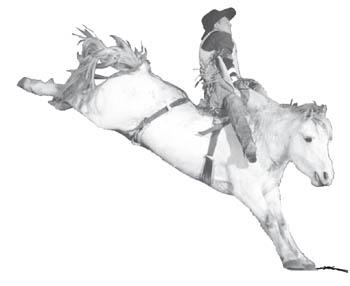
Dust, animal sweat and cheap perfume hang in the air. The crowd laughs at the rodeo clown and chats about hot dogs while the announcer bellows the next contestant’s name. The gate opens and a cowboy- topped horse sprints out heading for the grandstands. The horse slams into the fence that separates audience from arena and the cowboy’s foot catches in the fence’s weave. The bronc departs, but the cowboy stays behind, ripped from the horse’s back and left dangling on the fence. Medics rush to the cowboy’s limp upside-down body. Meanwhile, the bucking horse struts toward the exit, confident he put on an impressive show, a job well done. True story.
At rodeos, saddle bronc and bareback horses are assigned to each cowboy at random. Horse assignment can mean the difference between winning and being strewn, unconscious from a fence. According to cowboy and upcoming College National Finals Rodeo contestant Jesse Kruse, “Rodeo is as much a drawing competition as a riding competition.” Riding bucking broncos originated from necessity. Cowboys saddled and rode wild, untrained horses to domesticate them. Bucking-out a horse was the first step in training. Today’s bucking horses are bred for their size and athleticism. Stock contractors breed them, raise them and transport them from rodeo to rodeo.
People are also reading…
Stock contractor Dick Wyman estimates that there are seven to eight organizations breeding bucking horses in Montana.
“Eighty percent of horses come from breeding programs,” noted Wyman. The other 20 percent are saddle horses that like to buck or horses that never got broken. These horses go to the Miles City Bucking Horse Sale where cowboys ride and contractors purchase new stock.
When contractors buy and breed bucking horses, they are looking for large, athletic horses. Wyman looks for a horse that is 1,200 to 1,400 pounds. He said little horses just can’t handle the strain.
Ike Sankey, the 1999 Professional Rodeo Cowboys Association’s Stock Contractor of the Year, has seen some good small bucking horses, but noted, that while a 140-pound boxer may be good, he is still no match for a 200-pound guy.
Anywhere from 10 to 120 horses accompany stock contractors to rodeos. Sankey stops by his Joliet ranch every one to two weeks to change stock. There have been times when he was on the road for up to five weeks.
Sankey starts bucking horses at four years old. At five, they are full-timers traveling to rodeos twice a month. On average, a bucking horse’s career lasts until they are about 12, although there are exceptions. Croppy is Wyman’s 26-year-old bucking horse, named for freezing his ears off as a baby. While some horses like Croppy can work into their 20s, most lose their athleticism.
Croppy will retire to the lush pastures of Montana. Other retired bucking horses go to small contractors or find homes on ranches with kids who dream of rodeo stardom. Still other bucking horses are sent to slaughter.
While horse slaughter is an acceptable practice among those who raise and care for bucking horses, the Virgie S. Arden American Horse American Horse Slaughter Prevention Act, currently pending in the senate, aims to stop the slaughter of horses in America. “Slaughter should not be an acceptable practice for horses, it’s not an alternative to euthanasia,” said Steve Smith of the Rolling Dog Ranch Animal Sanctuary.
Smith, who labels himself pro-rodeo, calls the process gory and inhumane.
Smith admits bucking horses are a different situation because it takes special equipment to vet them.
“If you’ve made your living using them,” he said, “is it too much to ask to give them a quiet, gentle ending?” Sankey worries that without legal slaughter in the U.S., horses will be neglected and abused. Furthermore, Sankey said, horses are, “still livestock in my opinion, they are not pets.” “You’ve got 90,000 head a year going to slaughter,” said Wyman. “That leaves a lot of horses in the market.” Wyman thinks horse prices will plummet when the market is forced to find homes for 90,000 additional horses every year.
Bucking horses are well cared for during their working life, but they are a commodity. When no longer competitive, many bucking horses are sent to slaughter, it’s a business decision. The Virgie S. Arden American Horse American Horse Slaughter Prevention Act will affect bucking horses and the people who make their living from them. Like apple pie, rodeo is about as American as you can get. If the cowboy is the delicious apple filling, the bucking horse is the crust. Without the crust, it’s not a pie. Without the horse, it’s not a rodeo.


