


BOZEMAN — A three-year grant worth $4.8 million is helping Montana State University continue its efforts to prepare more teachers to work in rural communities and to support those teachers while they are doing so. By the end of the grant, the program will have provided more than 900 learning experiences to increase MSU students' understanding and preparation for teaching in rural schools and engaged more than 400 rural teachers in professional mentoring.
The grant, from Margaret A. Cargill Philanthropies, will fund the third iteration of a program at MSU called ASPIRE, which stands for Advancing Support, Preparation and Innovation in Rural Education. The purpose of the program is to inspire and support Montana’s rural teachers through every phase of their teaching careers.
The first grant, awarded to MSU in 2021, was for $1.5 million. The second grant, awarded in 2024, was for $2.5 million.
People are also reading…
ASPIRE 3.0 will use what was learned in the two earlier phases of the program to increase the number of rural teachers who are recruited, prepared, mentored and retained in Montana, according to Jayne Downey, director of the MSU Center for Research on Rural Education, professor in the Department of Education and the project’s lead researcher. It will also develop a long-range sustainability strategy and durable funding model to embed rural teacher preparation and mentoring programs within existing state and institutional systems.
“We’re really excited about what this support will make possible over the next three years,” Downey said. “It will allow us to build on the strong foundation we've created through years of partnership building and program development. Most importantly, it will expand opportunities for MSU students to explore rural teaching. That investment benefits not only our students, but communities across Montana.”
Downey said that ASPIRE 3.0 will expand programs called Rural Teacher Pathways and MentorMT while working toward streamlining operations and institutionalization of the work at both the university and state levels. Those efforts will be supported by the continued development of the Rural Teacher Resource Hub, which contains resources like instructional materials and professional development support, and by establishing a project-wide database and developing a comprehensive, long-range sustainability strategy.
Rural Teacher Pathways
The Rural Teacher Pathways program is a sequence of immersive rural school and community clinical experiences for undergraduate students and high school students who are considering careers as teachers. For ASPIRE 3.0, Rural Teacher Pathways will continue to offer and build on existing programs known as Bridge to College and Road to Teaching.
Bridge to College is a program for rural high school students who are exploring teaching and other future college and career options. Bridge to College includes an online learning community and an MSU summer camp opportunity. In addition, fellowships worth $5,000 will be awarded to 18 students annually during their first year of college.
“This (part of the grant) is really going to allow us to grow our connections to Montana’s high school students who are interested in thinking about becoming a teacher, thinking about college,” Downey said. “This is an important investment in Montana’s students and Montana’s future. It’s really about helping prepare more teachers and support more teachers for our rural communities.”
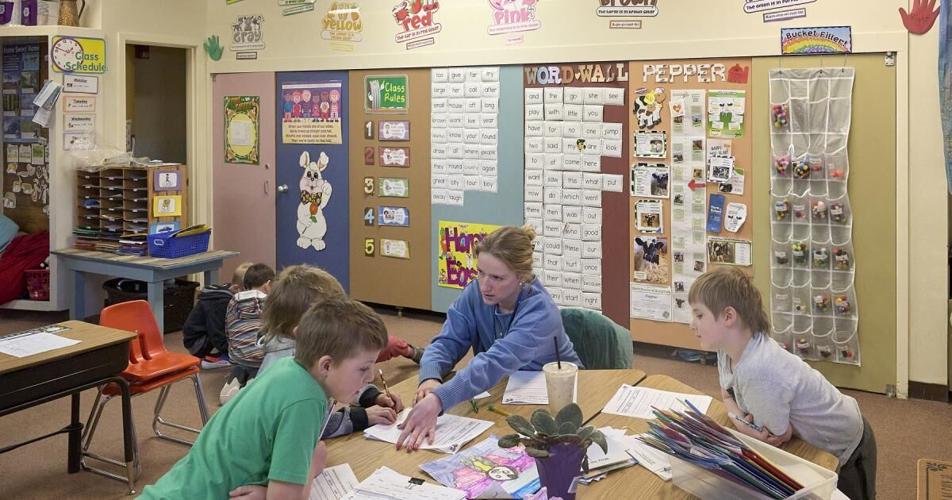
Through Rural Teacher Pathways’ Road to Teaching program, first-year MSU prospective teachers can engage in observing and assisting with instruction in one- and two-room K-8 schoolhouses. Second-year students have opportunities to spend multiple days visiting a rural school and community. Third-year students have the opportunity to participate in a weeklong experience, spending 8 to 10 hours per day in a rural school completing duties typical of full-time teachers. Finally, fourth-year students have the option of completing their 15 weeks of student teaching in a rural community, where they build relationships inside and outside the classroom and learn to embrace the strengths and assets of rural life.
To support students while they are on campus, MSU also offers community-building experiences, rural programming and opportunities for special projects. Rural Teacher Pathways also offers a teacher learning community for college students, which is intended to provide a sense of belonging and connection.
MentorMT
MentorMT provides expert, one-on-one mentoring for new and underprepared teachers who are filling positions in rural classrooms. The program is designed especially for teachers who are in their first or second year; on a provisional license; under emergency authorization with limited preparation; teaching outside their licensed grade level or subject area; or teaching on an international visa.
Through ASPIRE 3.0, the MentorMT program will train 150 additional mentor teachers and match them with up to 285 new rural teachers over the next three years. The program also aims to enhance the mentor-mentee experience by expanding access to expert knowledge for specialized subject matter; work to ensure durability and transferability of program components; and deepen practices that will sustain the program into the future, including work related to recruitment, administrator awareness and state agency coordination.
“The opportunity to provide mentoring for 285 new rural teachers is a way to show that the connection and support from MSU doesn’t stop,” Downey said. “We want (individuals) to be successful before they get to us, when they’re with us and after they graduate. MSU wants to provide that kind of professional support all along the way.”
Commitment to sustainability
Finally, ASPIRE 3.0 will develop a user-friendly, relational database to centralize all program data into a coherent, interconnected system. The database will enable accurate tracking, efficient reporting and meaningful analysis across all components of the project, Downey said. It will also provide information to help guide decision-making, demonstrate impact and ensure the Rural Teacher Pathways and MentorMT programs can continue into the future.
Downey noted that since ASPIRE started in 2021, more than 500 students have participated in Rural Teacher Pathways.
“What has been most encouraging is our students’ enthusiasm,” Downey said. “They are eager to learn, grow and explore how they can contribute to their schools and communities.”
Downey credited rural schools and communities across Montana for the program's success.
“Our partner schools and communities have welcomed our students with open arms,” she said. “They have created meaningful opportunities and shown students just how valued and needed they are.”
For Downey, the impact extends far beyond teacher recruitment.
“This is an investment in the future of rural Montana,” she said. “Schools are at the heart of rural communities, and by supporting future educators, we're helping sustain the people, places and communities that make Montana strong.”


