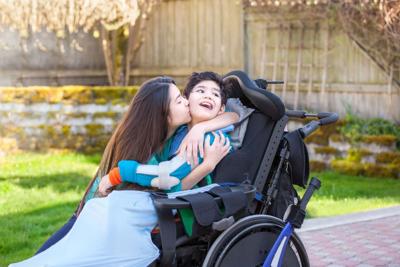


Photo provided by DepositPhotos
In disability advocacy circles, they have a name: glass children. Not because they're fragile, but because the adults around them often look right through them, focused instead on the brother or sister with higher medical needs. For families raising a child with cerebral palsy, this dynamic plays out quietly across the country, and researchers have been studying its effects for decades.
Now, a growing body of psychological and developmental research is putting numbers behind what these siblings have long described. The findings paint a complicated picture. There are real mental health risks, but there's also a striking pattern of resilience and adult achievement that deserves a closer look.
What the Research Shows About Sibling Mental Health
People are also reading…
Peer-reviewed studies have consistently identified elevated risks of anxiety and depression among siblings of children with chronic disabilities. A systematic review published in Clinical Child and Family Psychology Review found that siblings of youth with developmental disabilities face heightened psychosocial challenges. Longitudinal research published in 2025 confirmed that having a sibling with an intellectual or developmental disability affects well-being and behavior over time.
Researchers have also documented what's known as "parentification," where younger or same-age siblings take on caregiving roles typically reserved for adults. A study published in the National Library of Medicine examined how parentification and family stress shape the bond between adult siblings and their brothers or sisters with disabilities, drawing on family systems theory to explain why one child's diagnosis affects every member of the household. When one child requires significantly more medical and logistical resources, the family equilibrium shifts. Siblings often respond by becoming hyper-independent or hyper-responsible.
But the research doesn't stop at the challenges.
The Strengths That Show Up in Adulthood
Research on resilience as a protective factor in adolescents with a disabled sibling found that personal competence and tolerance for negative affect predicted a lower risk of internalizing disorders. The same household conditions producing stress can also build durable coping skills. Other research has highlighted that early exposure to caregiving doesn't just shape personality, it shapes professional trajectories. Siblings of children with disabilities are disproportionately represented in healthcare, education, and social work.
The same conditions that create stress can also create capability.
Siblings Are Becoming Long-Term Caregivers
This is where the research gets relevant for parents planning long term. According to the Caregiving in the US 2025 report from AARP and the National Alliance for Caregiving, 63 million Americans are now family caregivers, a nearly 50% increase since 2015. One in three of those caregivers is under age 50, and the report documents a rising share of long-term caregiving relationships involving family members with disabilities.
As medical care improves and life expectancy for people with cerebral palsy continues to extend into adulthood, siblings are increasingly stepping into roles as care coordinators and legal guardians later in life. American Community Survey data analyzed in 2022 shows that beyond the 43 million people living with disability in the U.S., another 42 million live in households with someone who has a disability. Multigenerational households are more common in these families.
That's twice as many people touched by disability at the household level than individual-level statistics suggest.
Evidence-Based Support for Siblings
The strategies are simpler than you might expect. Open communication about the diagnosis and dedicated one-on-one time with the non-disabled sibling show up repeatedly in the research as protective factors. Sibling support groups give kids a space to talk to peers who actually get it.
Families looking for guidance on supporting every child in the household can find resources at the Cerebral Palsy Center, which approaches care from a whole-family perspective.
The Policy Gap That Keeps Glass Children Invisible
The U.S. healthcare and education systems have built infrastructure around children with disabilities themselves. The infrastructure around their siblings is almost nonexistent. There's no IEP equivalent for the brother in the next bedroom. No mandated check-ins from a school counselor. No federal funding stream.
As more children with cerebral palsy live longer adult lives, the sibling experience stops being a side note. The research has been there for years. The systems built around families are only now starting to catch up.