

Healthy eating made easy
6 tips to make better choices
Dr. Howard Lewine
Harvard Health Publications
I’m sure you know the recipe for a healthy diet: more fruits and vegetables, less salt and added sugars, and cutting down on processed foods. It sounds simple enough. Yet so many people struggle to follow a healthy diet.
So, if we know how to eat healthy, why doesn’t everyone do it? Part of the problem lies in people’s misguided assumptions. Many still view healthy eating as being too restrictive — low fat, low carb, low calorie, low sugar. Then there are the perceptions that healthy foods are expensive, they’re not tasty and the recipes are too complex.
How can you overcome these misconceptions about healthy eating?
First, review your usual dietary habits. For a week, write down what you eat for every meal and snack, including the amount and the timing.
Next, adopt some small changes that can help fill in the gaps and expand your current good eating habits. Here are some suggestions.
1 Don’t be too ambitious
You don’t have to make multiple significant dietary changes at the same time to reap health benefits. Change one thing in your diet for three to four weeks. Once it becomes a staple of your diet, move on to another area and repeat the process.
2 Adopt a vegetarian day
Once a week, go vegetarian for the entire day and eat nothing but fruits, vegetables and whole grains (with perhaps a touch of dairy or eggs) and no processed foods. You may discover that vegetarian options are more appetizing than you expected. As you get more comfortable, increase it to twice a week or even more often.
3 Expand good habits
For instance, if you eat a daily serving of whole grains, add another one to an everyday meal by substituting it for something less healthy. This helps choosing healthy foods feel more automatic and less like a chore.
4 Cook something new
If dealing with recipes, ingredients and cooking feels intimidating, focus on creating just one new meal per week, which can help make preparing meals less daunting.
5 Enlist your friends and family
Everyone has a favorite dish, so ask around for suggestions.
6 Try new foods
During your next grocery-store trip, buy something you rarely, if ever, eat. When at a restaurant, order a dish made with a new-to-you food. And don’t forget to always approach healthy eating with an adventurous spirit. Healthy eating is not a one-day thing. Make it an exciting part of your life, where you are open to trying new foods, ingredients and dishes, all of which can make healthy eating fun.
Ways you can stave off colorectal cancer
Barbara Intermill
We may joke about the prep involved for a colonoscopy (an exam for abnormal changes in the large intestine). But cancers of the colon or rectum are no laughing matter. In fact, when you combine the cancer death rates of men and women, colorectal cancer is now the second deadliest cancer in the United States, according to the American Cancer Society.
Yet this disease is highly preventable, especially when we routinely submit to the screening procedure (which has proven to be much more comfortable than it once was, thank you). Experts say the chances for survival from colorectal cancer are drastically increased if any problems are caught and treated early.
Colorectal cancer is also highly preventable with a few changes in our eating and exercise habits. In 2018, the American Institute for Cancer Research published a report that outlined the latest research that links diet, nutrition and physical activity with the development of colorectal cancer.
These recommendations are based on what these experts report as strong and convincing evidence:
- Keep your weight as close to a normal weight as possible. Excess body fat is one of the strongest factors that increase one’s risk of colorectal cancer, says the American Institute for Cancer Research.
- Be physically active at least 30 minutes a day or a total of 150 minutes a week. Any type of physical activity, including leisure time, housework or formal exercise, goes a long way to help maintain a healthy weight.
- Eat very little, if any, processed meat — that which is smoked, cured, salted or otherwise preserved. This includes favorites like bacon and sausage. Research has shown that the more of these foods we eat, the greater one’s risk for colorectal cancer.
- If you drink alcohol, limit yourself to no more than two drinks a day. What’s a “drink”? A 12-ounce can of beer, 5 ounces of wine or 1.5 ounces of 80-proof distilled spirits. Alcohol use is one of the top three controllable risk factors for cancer, behind smoking and obesity, say these experts. These recommendations are supported by evidence deemed “probable” but not convincing:
- Eat a diet rich in whole grains. While no exact amount is specified, it has been shown that eating these foods may help decrease one’s risk for colorectal cancer. How? They contain dietary fiber and other substances with properties that fight off this type of cancer.
- Enjoy dairy foods like milk, cheese and yogurt. Studies show that as the intake of these foods goes up, the incidence of colorectal cancer goes down. Experts attribute this to the calcium and other properties in these foods that appear to protect the gut.
- Limit your intake of red meat (defined as beef, pork, lamb and goat) to no more than 18 ounces (six deck-of-cards-size servings) per week. Increased risk for colorectal cancer is seen at higher levels.
- And of course, eat lots of fiber containing (plant) foods like vegetables, fruits, legumes and lentils. These foods are rich in nutrients and phytochemicals that help fight off the growth of cancer cells.
What does this look like in daily meal planning? Check out the American Institute for Cancer Research’s “New American Plate” at www.aicr.org.

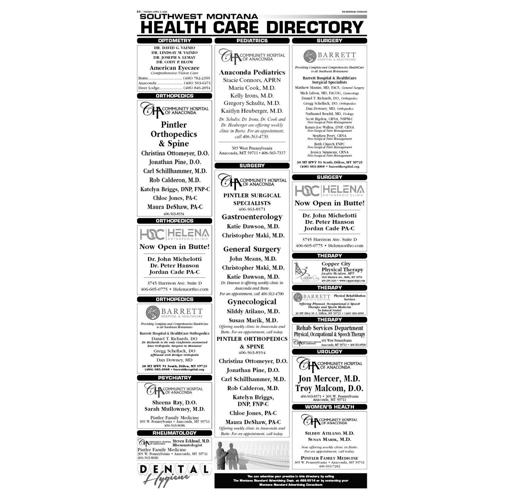
Southwest Montana Health Care Directory