

Quell the swell
How wearing compression socks can help your legs
Harvard Health Publishing
You may have seen compression socks on a range of people — everyone from a family member on bed rest to a seat mate on a long-haul flight to a neighbor training for a marathon. Or perhaps you’ve seen stories in the news noting that compression socks are considered “cool” among millennials.
“And yet, there’s generally not consensus in the medical world that the average person needs to wear compression stockings,” says Dr. Robert H. Shmerling, senior faculty editor at Harvard Health Publishing and former clinical chief of Rheumatology at Beth Israel Deaconess Medical Center.
Who are compression socks for, then? And how do they work?
What are compression socks?
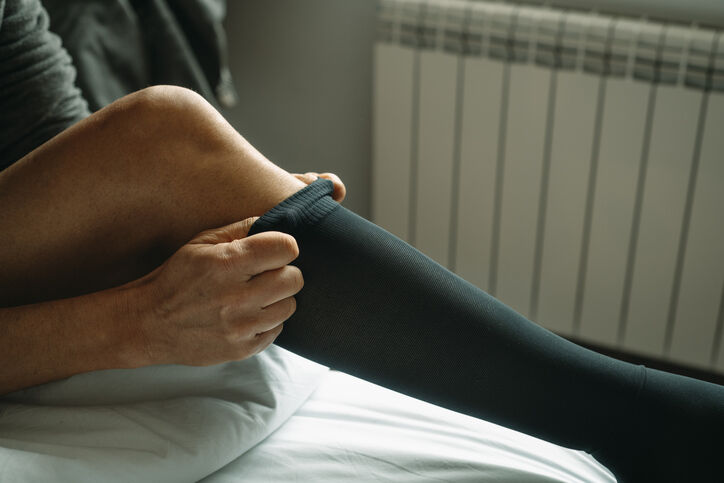
Compression socks are tight stockings that put pressure on your legs. Some go just to the knee, some above the knee and others can go all the way up to your abdomen. Some compression socks work on a gradient, meaning their pressure is highest at the ankle and gradually decreases higher up the leg. Others have consistent pressure.
Compression socks are intended to prevent and treat edema, or swelling, and to prevent blood clots in the legs.
What are the benefits?
The job of compression socks is to squeeze your legs, which in turn squeezes the blood vessels in your legs. The effect: better circulation, less swelling and, perhaps, relief from leg pain.
Increasing pressure on your legs to help blood flow more easily may seem counterintuitive, but a quick primer on circulation can explain why. Whether standing or sitting, you spend most of your day upright, Shmerling says. In order for blood to fl ow against gravity back toward the heart, leg veins have special valves to help prevent it from going backward.
“The way these little valves are designed, blood flow can only go in one direction,” Shmerling says. “With the help of leg muscle contractions, blood goes through the valves, they close behind it, and blood moves in the correct direction toward the heart, and everything’s good.”
In some people, these valves fail over time — a condition called venous insufficiency. This causes blood and fluid to pool in your legs and make them swell. By squeezing your legs, compression socks help the valves in your blood vessels do their job.
Who should use them?
Compression socks are a standard treatment for certain health conditions, such as chronic venous insufficiency, varicose veins and edema in the legs. They are also used to prevent formation of blood clots in the legs, known as deep vein thrombosis, for people at high risk of developing them.
Older adults are more prone to leg edema and benefit from compression socks if they are obese, have experienced previous blood clots or leg injuries or are bedridden.
But sometimes, even healthy people deal with leg edema as their valves fail with age.
Younger people who benefit from compression socks are typically those with certain health conditions or pregnant women.
Your primary care physician can help you determine if compression socks could treat your edema or varicose veins, or prevent swelling or blood clots in the legs. They may suggest you see a vascular specialist.
Where do you get them?
You can purchase compression socks over the counter at medical supply stores and some pharmacies.
In some cases, you may need a prescription for them. For example, Shmerling explains that over-the-counter stockings may not work if you have very severe edema. A prescription might also be needed if you are planning to ask your insurance company to cover the cost.
If a prescription is needed, your medical team will measure your legs and make sure the size and pressure are right for your specific needs.
Wearing compression socks
Because of their intentionally snug fit, compression socks can be difficult to put on. The following tips can help.
- bunch the socks up and turn the toe inside out, then put your foot in, pull the sock over your heel, then work the rest of the sock up your leg.
- Trim your toenails and smooth any rough skin patches to prevent snags.
- Wear rubber gloves.
- use a powder like cornstarch or baby powder to absorb any wetness or sweat that can make it harder to get the sock on.
- using a gadget called a donner, which holds the socks open for you, can help if you struggle to get compression socks on.
How long to wear them
Typically, it’s best to put on compression socks when you first wake up and your legs are the least swollen, shmerling says.
Wear the socks all day, when you’re upright and need a little help fighting gravity to get blood moving through your legs back up to your heart.
Because you don’t need that extra oomph when you’re lying down, you can remove compression socks at night when you sleep. Just remember to put the socks back on in the morning.
Study: Wildfire smoke linked to 24k deaths a year
Dorany Pineda
Associated Press
Chronic exposure to pollution from wildfires is linked to tens of thousands of deaths annually in the United States, according to a new study.
The paper, published last week in the journal Science Advances, found that from 2006 to 2020, long-term exposure to tiny particulates from wildfire smoke contributed to an average of 24,100 deaths a year in the lower 48 states.
“Our message is: Wildfire smoke is very dangerous. It is an increasing threat to human health,” said Yaguang Wei, a study author and assistant professor in the department of environmental medicine at Icahn School of Medicine at Mount Sinai.
Other scientists who studied the death toll from wildfire smoke were not surprised by the findings.
“The estimates they’re coming up with are reasonable,” said Michael Jerrett, professor of environmental health science at the University of California, Los Angeles who was not involved in the study. “We need more of them. It’s only if we’re doing multiple studies with many different designs that we gain scientific confidence of our outcomes.”
The paper’s researchers focused on deaths linked to chronic exposure to fi ne particulate matter, or PM2.5 — the main concern from wildfire smoke.
These particles can lodge deep in lungs and enter the bloodstream. Short-term exposure can trigger coughing and itchy eyes, but longer term, they can make existing health problems worse and lead to a range of chronic and deadly health issues, including respiratory illness, cardiovascular and neurological diseases, as well as premature death.
“Wildfire smoke PM2.5 has emerged as significant environmental hazard in the U.S., and it’s driven by increasing frequency and intensity of wildfires due to climate change,” said Min Zhang, a postdoctoral student at the Icahn School and a study author.
Along with decades of forest mismanagement, growing development in fire-prone areas has expanded the “urban wildland interface,” increasing wildfire risk with real consequences for human health, said Jerrett.
“Nobody’s going to have ‘wildfire death’ on their death certificate unless the fire actually burned them or a tree fell on them or something like that,” Jerrett said. “But many of the people that are dying from this exposure are ones that are already more vulnerable. These are real lives that are being lost. This is not some arbitrary abstract statistical concept.”
The study’s authors analyzed the link between annual average exposure to PM2.5 from wildfire smoke and deaths by county in the lower 48. They used federal mortality data across 3,068 counties of all causes of death and several specific ones — circulatory, neurological and respiratory diseases, as well as mental and behavioral disorders, tumors and endocrine, nutritional and metabolic diseases.
They also included deaths related to falls and transport accidents — which are unlikely to be linked to wildfire smoke — to ensure their other observations weren’t biased.
“We found no association for car accidents and falls, while for other diseases we found statistically significant effects,” Wei said. Deaths from neurological diseases saw the biggest increase with exposure to these particulates.
How pronounced the link was between particulate exposure and death varied by season and demographics. A stronger association appeared during cooler periods, and people in rural areas and younger communities appeared to be more vulnerable.
Researchers also found that with every 0.1 microgram per cubic meter increase of PM2.5 across all these places, about 5,594 more people died each year.
Jerrett said the study had the benefit of a large study population and includes most causes of deaths in the U.S. Still, he said the county-level data could have led to over or underestimates because wildfire smoke is very dynamic. “It doesn’t just blanket a large county all at once. There are going to be parts of the county that gets it a lot worse.”
The study also did not account for other important factors, such as whether a person smokes, he said.
Kai Chen, an associate professor of environmental sciences at the Yale School of Public Health who also studied the topic, said: “I really like that they examined both the smoke and nonsmoke PM2.5.” Various research found that PM2.5 from wildfire smoke has greater health effects than pollution from other sources, such as car emissions, Chen, who was not involved in the study, said in an email.

Southwest Montana Health Care Directory