

Is it really GERD?
Many conditions have similar symptoms; here's what to know
Maureen Salamon
Harvard Health Publishing
Decades of severe heartburn and other symptoms of gastroesophageal reflux disease, or GERD — a highly common condition in which stomach acid washes backward into the esophagus — had worn Clara down. By the time she was in her 80s, she had long since stopped trying to manage the problem. She ate foods she knew would trigger symptoms, didn’t take medications as directed and skipped lifestyle changes her doctor recommended.
When Clara started having trouble swallowing, she chalked it up as another GERD symptom and ignored that, too. But this time it meant something far worse: esophageal cancer, the sixth leading cause of cancer deaths worldwide.
Most cases of GERD don’t lead to esophageal cancer, a Harvard expert says. But recurrent or persistent acid reflux should be evaluated and addressed — not only because untreated GERD can damage the esophagus, but because symptoms you think are “just GERD” can signal other health problems, some of which may be life-threatening.
“It’s important to know what you’re dealing with — whether it’s GERD or something else,” says Dr. Elena Fradkov, a gastroenterologist at Harvard-affi liated Mount Auburn Hospital. “And if it’s something as scary as a heart attack, you don’t want to miss it.”
Look-alike conditions
Heartburn is perhaps the most pervasive GERD symptom. “But you may also have an acidic or metallic taste in your mouth, a hoarse voice, chest pain, a dry cough, or post-nasal drip,” Fradkov says.
These symptoms can overlap with those of several other conditions, including the following:
- Hiatal hernia: A condition in which part of the stomach protrudes up through the diaphragm (a sheet of muscle that separates the chest cavity from the abdomen), a hiatal hernia might trigger GERD or simply coexist with it, often without causing any symptoms itself, Fradkov notes. “Normally, the diaphragm sits where the esophagus and stomach meet,” she explains. “When there’s a hiatal hernia, the top of the stomach looks almost like a tube of toothpaste that’s being squeezed in the middle.” This can cause symptoms associated with GERD.
- Functional dyspepsia: This is a complicated name for stomach discomfort, pain or chronic indigestion that doesn’t stem from an identifi able cause. “There’s no acid reflux into the esophagus,” Fradkov says. “But people who have it can have symptoms of GERD anyway.”
- Eosinophilic esophagitis: Eosinophils are a type of white blood cell involved in allergic reactions. When they collect in the esophagus, this allergic condition inflames the muscular tube, causing difficulty swallowing and other GERD-like symptoms. “The main difference is that eosinophilic esophagitis typically involves much more classic trouble swallowing or food getting stuck,” she says, “whereas typical GERD symptoms include burning, a metallic taste in the mouth, hoarseness or bad breath.”
- Esophageal spasms: Certain medications, as well as eating very cold or very hot foods, can cause involuntary contractions of the esophagus. Like GERD, these spasms can prompt pain, difficulty swallowing and the feeling that food is stuck in your chest.
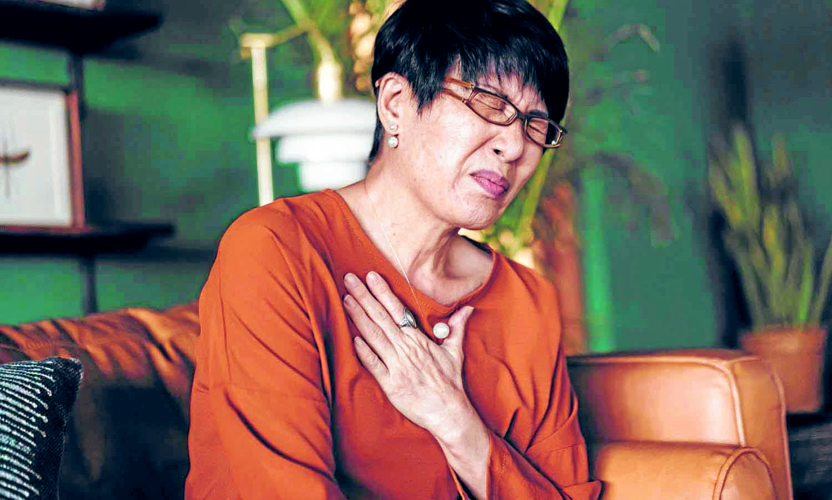
- Heart attack: Heart attacks sometimes involve a burning sensation along with more typical chest pain. “You may think it’s just your GERD, but if you’re also sweaty, having trouble breathing, or feeling pain that extends into your back, you need to go to a hospital,” Fradkov says.
Proactive strategies
Depending on your age and other health problems, diagnosing GERD may involve various tests, including an endoscopy, in which a doctor looks directly at the esophagus lining using a camera on a tube passed down the throat.
“We can sometimes see inflammation in the esophagus,” Fradkov says. “That will confirm a GERD diagnosis or allow us to rule out other causes.”
If your symptoms are indeed caused by GERD, your doctor may recommend over-the-counter or prescription medications. But the following lifestyle changes can usually help you manage most or all of the symptoms, Fradkov says.
1 Avoid common triggers: Alcohol, coffee, chocolate, tomato sauce, carbonated drinks, peppermint, citrus fruits and juices, and fried, greasy or acidic foods are all off enders.
2 Stretch out your eating: Instead of three large meals each day, divide your intake into five or six smaller ones, and eat more slowly.
3 Stay upright after meals: This helps gravity move foods and drinks downward, instead of allowing stomach contents to back up into the esophagus. Don’t eat in the two to three hours before bedtime, and try elevating your upper body in bed with a foam wedge under your mattress.
4 Control your weight: Carrying extra pounds, especially in the belly, places more pressure on the sphincter at the bottom of the esophagus that keeps food in the stomach. “It’s pure mechanics,” Fradkov says. “The more abdominal mass you have, the more it’s going to push on your stomach and squeeze things upward.”
Community key to rural food insecurity solutions
Molly Wetsch
South Dakota News Watch
In rural and reservation areas across the state, communities are coming together to combat food insecurity in areas where food support can be few and far between.
According to a 2023 study from Feeding America, over half of food insecure people in South Dakota are above the income threshold to receive Supplemental Nutrition Assistance Program (SNAP) or Women, Infants and Children (WIC) benefits. Some of the largest proportions of food insecure people live in the state’s most rural areas, including in the nine reservations in the state.
Todd County, Oglala Lakota County and Corson counties have the highest percentages of people who don’t regularly get enough to eat, with an estimated more than 20% of the population experiencing food insecurity as of 2023.
Across the state, successes in food insecurity intervention often come when those who live in the community take stake to ensure that all of the area’s residents can put food on the table.
Those smaller, often volunteer-led operations frequently take initiative to make sure people in the most remote corners of the state can feed their family.
The Cheyenne River Sioux Tribe Buff alo Authority Corp. received a U.S. Department of Agriculture Local Food Purchase Assistant (LFPA) grant last fall to distribute food items across the Cheyenne River Indian Reservation. The organization has the largest tribally owned buffalo herd in the country and regularly distributes bison meat across the reservation. The grant program also allows the group to purchase and distribute other food items, like fresh produce.
Irona Howe, who runs the organization’s Farm to School program, said that food programs are for everyone, regardless of income status – an important marker, she said, especially considering that many who may need food in the short-term don’t necessarily qualify for federal government benefits.
“There’s no questions asked. We haven’t turned anybody away for food,” Howe said. “It doesn’t matter what color you are, everybody is welcome. You’re welcome to come to every distribution if you want to. People say, ‘I don’t qualify for that.’ But it’s really cool to say, ‘Yeah, you do. Come, this food is for you.’”
At a recent distribution in Eagle Butte, where the Cheyenne River Sioux Tribe’s headquarters are located, the organization distributed more than 9,000 pounds of ground beef as well as local honey and other fresh produce. It was one of several food distributions the organization has been conducting across the reservation this winter.
Food distribution can also be an exercise in community building, especially when those communities are smaller, with limited resources. Howe said that distribution days, which take place in towns across the nearly 1.6 million-acre reservation, are crucial to ongoing connection.
“I ordered a flatbed full of watermelon, and I was able to go to each and every single individual community and knock on their doors and give out watermelon,” Howe said.
Across the state, in Centerville, where the population is 958, residents often go above and beyond to give to the food pantry, according to volunteer Jackie Hofer.
The town’s Rotary Club runs the pantry, which gets distributions from Feeding South Dakota and the local grocery store. The pantry runs for an hour on Wednesday nights and usually sees about 40 visitors a month, Hofer said. Most members of the Rotary Club make eff orts to volunteer.
“Even individuals (give to the pantry),” Hofer said. “We had one individual who, at one time, was giving $100 a week to the pantry because he said at one point he was down on his luck and he found a way to give back.”
That level of involvement is not uncommon at small, rural food pantries, Hofer said. Local businesses regularly give to the pantry and coordinate drives to ensure it can remain up and running. On most Wednesday nights, the pantry is fully stocked with extras in the back.
“You can’t do it by yourself,” Hofer said. “That’s kind of the big thing.”

Southwest Montana Health Care Directory