

Intro to Pilates
How to get started with this low-impact exercise
Harvard Health Publishing
Pilates is once again growing in popularity after first going mainstream in the early 2000s. Nearly 12 million Americans tried the low-impact workout in 2023, 15% more than during the previous year. The attention on this exercise workout might make you wonder if Pilates is a good option for you.
What is Pilates?
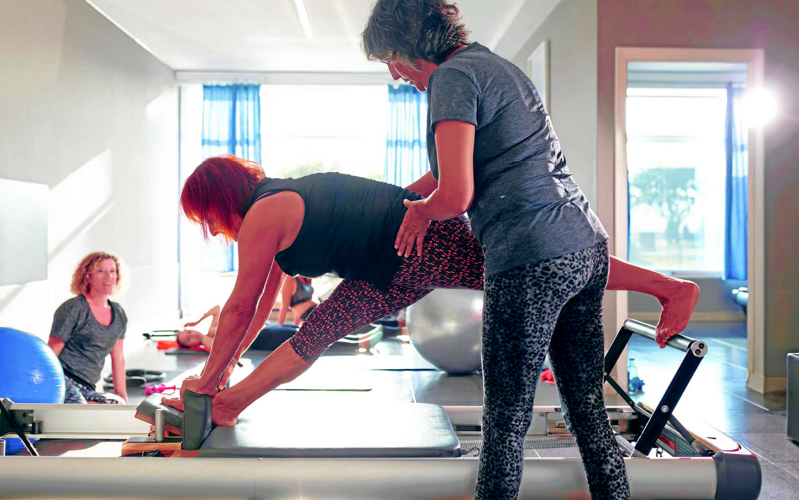
Pilates is a form of exercise invented by a German fitness enthusiast named Joseph H. Pilates. His system involves movements meant to improve balance, flexibility and strength, especially in your core. (“Core” refers to the muscles in the back, sides, pelvis and buttocks that stabilize the center of the body to improve efficiency of movement.) Pilates may be performed using either a mat and your own body weight, or a specially designed piece of equipment called a Pilates reformer that provides resistance. Today, Pilates is available at many fitness facilities, and you also can find workouts online.
Potential benefits for mature bodies
Pilates isn’t just about stretching and strengthening your muscles. It also has been linked to benefits that can be particularly important as we get older. For example, practicing Pilates might help you:
- Improve posture.
- Maintain bone density.
- Protect against cognitive decline.
- Improve back pain.
- Support the immune system.
- Bolster mental health.
Plus, Pilates is a low-impact form of exercise, meaning it might be more comfortable and accessible if you have joint pain or if it’s tough to get around. Safety considerations It’s generally a good idea to check with your doctor before trying any new kind of exercise, including reformer Pilates, mat Pilates or wall Pilates. (Wall Pilates uses the support of a wall to add resistance to an at-home Pilates workout.)
Your doctor may recommend that you avoid certain Pilates exercises if you have existing back pain or spine issues.
Giving it a try
Once your health care provider has cleared you to try Pilates, look for a local studio or community center that offers Pilates for people ages 55 and older, or Pilates for beginners.
Plan to arrive early for your first visit, so you have time to let the instructor know about any concerns or questions you have about the workout. He or she will introduce you to the movement patterns and show you how to practice Pilates safely.
Also, an experienced Pilates instructor can help you tailor a workout to your unique needs and abilities. That might include trying a modified version of Pilates.
Gentle Pilates
Pilates is generally considered a low-impact form of exercise. But certain Pilates classes may be marketed as “gentle Pilates for seniors” or for beginners of any age.
These classes often focus on exercises that go easy on the joints. Gentle Pilates also may have added emphasis on breathing techniques or be more easily adaptable to various fitness levels and abilities.
Chair Pilates
Pilates is often performed while you’re lying down on a mat or the reformer machine. If you’re more comfortable exercising in a chair or if lying down is difficult for you, you may be able to find a local studio, community center or online platform offering chair Pilates. In chair Pilates, you perform the strengthening and stretching motions while seated.
Note that the term “chair Pilates” also can refer to the use of a Pilates machine called a Wunda chair, which can further challenge your core muscles. Be sure to check ahead of time to make sure you’re signing up for the version of chair Pilates you want.
Violent videos can take a toll on mental health
Rachel Hutton
The Minnesota Star Tribune
Graphic footage of Renee Good’s fatal shooting on Jan. 7 by Immigration and Customs Enforcement agent Jonathan Ross and videos of the killing of Alex Pretti on Jan. 24 by federal agents flooded the internet, along with other depictions of violent confrontations between Department of Homeland Security officers and people in Minnesota.
Social media has enabled us to vicariously witness many harrowing scenes as masked federal agents, carrying military-style fi rearms, smash car windows and tackle people to the ground. Protesters, observers and community members have pushed back, shouting profanities at agents and at times throwing things at them.
This secondhand exposure to violence takes a toll. Research studies following major attacks or natural disasters have shown that people who repeatedly watched graphic footage of the events experienced elevated levels of post-traumatic stress, said professor James Densley, chair of the School of Criminology and Criminal Justice at Metro State University in Minneapolis.
“In some cases, the mental health impact actually rivals that of people who are indirectly connected to the events,” he said.
Densley shares how watching violent videos can lead to secondary or vicarious trauma — especially as social media amplifies their effect — and how to stay informed while protecting your mental health.
Could you explain the psychological impact these videos have on viewers?
You can get anxiety, intrusive thoughts, sleep disruption. It’s when someone absorbs the emotional and psychological weight of another person’s suffering, through that repeat exposure. And that’s a stress response that’s virtually indistinguishable from direct exposure.
How is this response different from empathy?
Empathy is feeling for others and a trauma reaction is a biological stress response. Empathy is a good thing that can motivate constructive engagement. But when your nervous system is repeatedly activated by scenes of violence, people instead develop hypervigilance, numbing or avoidance.
The public has watched footage of traumatic events on television for decades. What’s different about social media?
After 9/11, people might have watched the same clip on the nightly news loop. But today, social media is pushing violent footage continuously, unpredictably and often without warning. So from a stress-response perspective, that means the brain never fully gets a chance to stand down.
And today’s footage is much more immersive than that of, say, President John F. Kennedy’s assassination or the Vietnam War.
Back then, it felt somewhat filtered and distant, not just because of the editing of newsrooms, but also just because of the quality of the footage. Now everything’s in high definition and surround sound, so it’s much more realistic.
How do our brains react to these images?
The human brain isn’t built to just passively scroll through scenes of real violence without consequence. Every time you watch a clip like this, I think the nervous system responds as if it’s happening to you, not to a stranger far away. Then every additional viewing compounds that stress. So, contrary to the idea that people just get used to it, the repeated exposure deepens the emotional exhaustion and distress.

Southwest Montana Health Care Directory