

Ahead of the curve
Can you prevent the hunched back of kyphosis? Maintaining good bone health, posture and ergonomics can help.
Lynne Christensen
Harvard Health Publishing
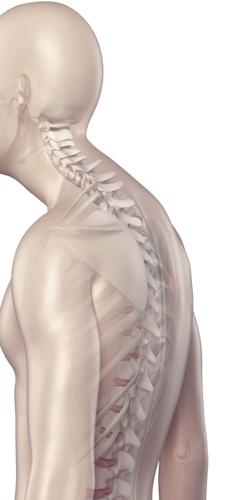
Having the bone-thinning disease osteoporosis puts you at risk for developing an excessive forward curve in the upper spine called hyperkyphosis, sometimes referred to just as kyphosis. But osteoporosis is not the only factor: Age-related degenerative changes in the spine and poor posture can also cause or worsen the condition. Plus, genetics plays a role in your risk.
You can’t change your genes or stop the aging process. Still, “even if you’re destined to have hyperkyphosis, you can slow down the process or reduce it to some degree,” says Nancy Capparelli, a physical therapist at Harvard-affiliated Beth Israel Lahey Health.
What causes hyperkyphosis?
With osteoporosis, low bone density can lead to small breaks (compression fractures) in the vertebrae of the spine, often in the front part of these bones.
Over time, some vertebrae can collapse, causing the spine to curve forward.
Shock-absorbing spacers (discs) sit between the vertebrae of the spine. Over time, these discs dry out and break down a bit, explaining why we lose height as we age. The force of gravity on degenerating discs also can cause you to bend forward at the upper spine.
Poor posture and weak muscles in the back and neck also can lead to spinal curvature or worsen it.
Maintain bone health
If you want to minimize the chance you’ll develop kyphosis later, start now to maintain your bone health. Stay up to date on bone density scans, which for women should start at age 65 and for men at age 70. People with risk factors for osteoporosis should start screening earlier. Talk to your doctor about the timing.
Get adequate amounts of calcium, vitamin D and weight-bearing exercise to keep bones strong. Recommended daily intake of calcium is 1,200 milligrams (mg) for women over 50 and men over 70, and 1,000 mg for men ages 51 to 70. The recommended daily intake of vitamin D is 600 international units (IU) for people up to age 70 and 800 IU after age 70. Weight-bearing exercises are activities in which your body actively supports its weight and works against gravity, such as walking, running, dancing and using an elliptical trainer.
If you have low bone density, your doctor can prescribe medications.
Correct your posture
“One of the most important things you can do, sooner rather than later, is to pay attention to your posture and ergonomics,” Capparelli says. Don’t wait for your spine to start curving.
Avoid prolonged sitting. When working at a desk, take breaks about every 30 minutes. Use a chair with good back support. Don’t spend long periods hunched over, staring at your device.
Practice maintaining an upright posture while sitting, standing and walking. Keep your head up and aligned over your spine.
Strengthen your postural muscles
The key to maintaining good posture is strengthening the muscles in the upper back, neck and core. Doing this can also help prevent a curved spine from worsening. “The stronger your postural muscles are, the easier time they’ll have holding you up,”Capparelli says.
“I often see people start an exercise program by doing biceps curls and other exercises that only work the muscles in the front of the body,” she says. “They don’t work the upper- and mid-back muscles enough, so these people get muscle imbalance, which can contribute to hyperkyphosis.”
A physical therapist can help you design a suitable program of exercises.
When performing exercises, keep your head and neck straight and look ahead. “It’s common for people to want to look down,” Capparelli says. “But that accentuates the curve in the upper back and neck.” What to avoid Some exercises and positions should be avoided if you have osteoporosis because they can increase the risk of compression fractures. For example, refrain from exercises and other activities that require you to repeatedly bend the spine forward, such as curl-ups (in which you lie on your back and lift your upper torso off the floor) and toe touches from a standing position. Curving the spine forward while holding a weight also should be avoided.
Alcohol study at odds with federal guidance
Mary Walrath-Holdridge
USA Today
The “less is more” approach to alcohol may be replaced by “none is best” if you hope to avoid diseases like cancer, according to a new study at odds with recent federal guidance.
Adults should stick to one drink (generally 12 ounces of beer, 5 ounces of wine or 1.5 ounces of spirits) a day, or seven drinks total a week, if they hope to avoid the worst of health effects associated with alcohol, according to the study published this month in the Journal of Studies on Alcohol and Drugs. Even that rate is not devoid of risk, the study’s authors caution.
After conducting a largescale review of more than 7,200 studies on alcohol-related disease, the authors found the risk of serious illness or death from alcohol begins with drinking habits that generally are considered “moderate” by Americans. Seven drinks per week gives you a 1 in 1,000 lifetime risk of death, while adding just two more — for a total of nine drinks — increases that risk to 1 in 100.
If you stick to the old federal guidelines, which set a limit of two drinks a day or 14 drinks per week, that stat surges to a whopping 1 in 25 risk of death. These rates were fairly consistent, with relatively small variation, among men and women.
What’s worse for those who enjoy a glass with dinner: that old “a bit of red wine is good for you” wisdom is a myth. No amount of drinking provides any health benefits that outweigh the harms, according to the study.
“No protective effect of drinking was observed even at low levels,” study co-author Katherine M. Keyes, professor of epidemiology at Columbia University Mailman School of Public Health, said in a news release from the college. “… even moderate levels of consumption increase the risk of premature death and disability.”
At even just one drink per day or seven drinks per week, you are more likely to develop or die from associated conditions, including cirrhosis of the liver, cancer (including esophageal, oral and especially breast), cardiovascular disease and related injuries (like car accidents), than someone who doesn’t drink at all. The danger of developing some of these conditions, such as cardiovascular disease, is reduced by sticking to the one-drink-a-day rule, but it remains higher than in nondrinkers.
The bottom line? Drinking increases your risk of adverse health effects, no matter how small the amount. The more you drink, the higher those chances are, and they scale rapidly — at least according to this study.
What do federal guidelines say about drinking?
The new findings are at odds with previous federal health guidelines, which capped the recommended number of drinks at 14 per week for men and one drink per day or seven per week for women. They are also arguably not represented in the new dietary guidelines laid out in January by Health Secretary Robert F. Kennedy Jr.’s Health and Human Services Department and the U.S. Department of Agriculture, which opted for a vague suggestion to “consume less alcohol for better overall health” without specifying or defining consumption limits.
The study originally was commissioned by the Biden administration and partially funded by HHS, former agency official Robert Vincent wrote in an accompanying editorial, but was “sidelined” amid criticisms from the alcohol industry. Instead of informing the new federal guidelines, as originally intended, a draft first released last year languished until its publication this week, it said.
A January congressional report conducted under the Trump administration accused the study authors and Biden administration of bias and attempting “to undermine the 2025-2030 dietary guidelines,” which some alcohol trade groups pointed to as proof the study should be disregarded.
In part, the report points to affiliations of some researchers on the project as proof of bias, such as Dr. Kevin Shield, a researcher at the Institute for Mental Health Policy Research and Head of the World Health Organization/Pan American Health Organization Collaborating Centre in Addiction and Mental Health Centre for Addiction and Mental Health in Toronto, Canada.

Southwest Montana Health Care Directory