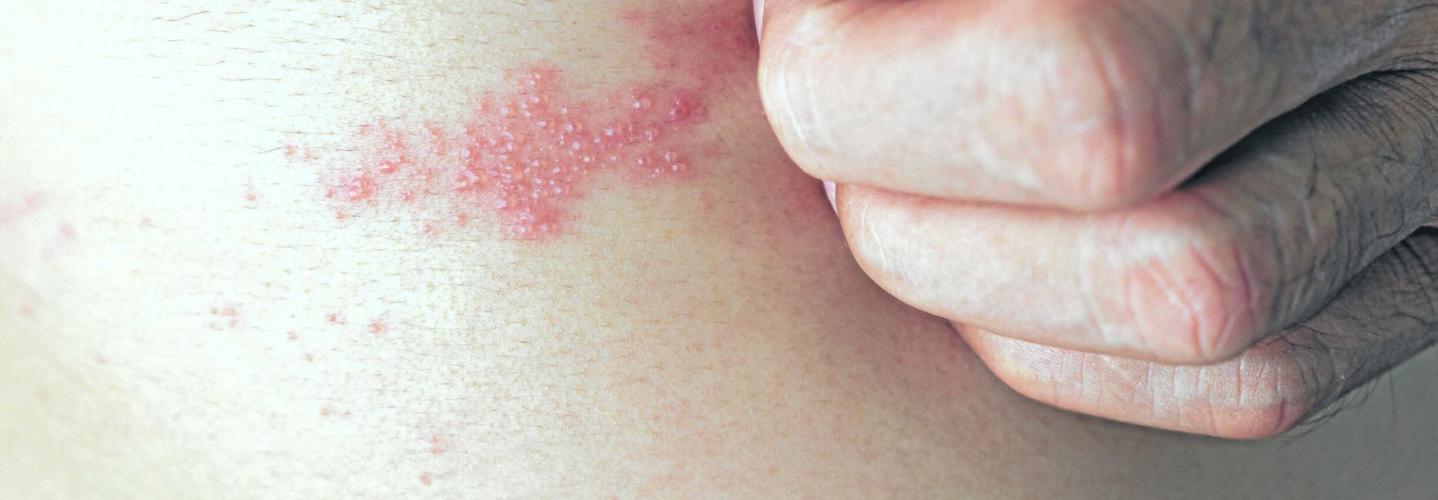


a shingles rash often occurs on the back, chest or abdomen.
Rash Decisions
What to do if you have — or suspect you have — shingles
Harvard Health Publishing
Tingling, itching or burning in one area on one side of the body. A day or two later, a blistering rash. That telltale sequence suggests you have herpes zoster, better known as shingles.
About one in three people in the United States will get shingles at some point. It can occur at any age but is most common after 50.
Who gets shingles?
Anyone who’s had chickenpox (often as a child) can develop shingles. This is because the varicella-zoster virus, which causes chickenpox, doesn’t go away once you’ve recovered from the illness; it lies dormant in the body. Later in life it can reactivate, causing shingles.
“Almost all Americans born before 1980 had chickenpox, even if they don’t know or remember that they did,” says Dr. Sharon Curhan, an epidemiologist at Harvard-affiliated Brigham and Women’s Hospital.
Shingles can develop in otherwise healthy adults, but some people are at higher risk. These include people with certain medical conditions, such as some cancers and infections, and people who take medications that may weaken the immune system — such as chemotherapy for cancer, medications to prevent organ rejection after a transplant and drugs used to treat autoimmune conditions such as rheumatoid arthritis or inflammatory bowel disease. Chronic mental stress also may increase the risk for developing shingles.
What to expect when you have shingles
The tingling, itching and burning that signal the beginning of shingles sometimes come along with a headache, a fever or a feeling of being unwell.
Once the rash appears, it’s often blistering and painful.
“It may look like a band or strip,” Curhan says. The rash typically affects one side and can occur anywhere on the body. It’s often on the back, chest or abdomen. It also can appear on an arm, a leg or the face or head.
Pain in the area of the rash is common and can be severe.
“It’s often described as a sharp, deep burning, throbbing, or stabbing pain,” Curhan says. Pain can interfere with sleep and the ability to go about daily activities. In three to four days, the blisters, called vesicles, can become open sores.
“In people with a healthy immune system, the sores crust over in seven to 10 days,” Curhan says.
The rash usually goes away in three to four weeks. Scarring and skin color changes can last longer.
Most people recover completely from shingles. But there may be complications, some of which can be severe and long-lasting.
Studies show that people who develop shingles are nearly 30% more likely to have a stroke or heart disease. They may be 20% more likely to experience a decline in cognitive function.
What to do if you have shingles
“If you think you might have shingles, contact a (healthcare) provider right away,” Curhan says. The earlier you can get a diagnosis and treatment, the more effective the treatment is likely to be.
A clinician can usually diagnose shingles based on your symptoms and the appearance of the rash. If the diagnosis is less certain, he or she may test a sample of the fluid from the rash for the presence of the varicella-zoster virus.
Treatment typically involves an antiviral medication such as acyclovir (Zovirax), famciclovir or valacyclovir (Valtrex). It’s most effective when you start taking it within three days of the rash appearing.
Antiviral medications can shorten the duration and reduce the severity of shingles.
Because shingles pain can be intense, you also may need pain medication. Nonprescription nonsteroidal anti-inflammatory drugs (NSAIDs) or acetaminophen (Tylenol) are often sufficient. Some people need prescription pain medications. If the rash becomes infected, you may need antibiotic treatment as well.
Managing symptoms at home
Keep the area clean and dry. “Don’t apply creams or gels to the rash unless your provider tells you to,” Curhan says.
Try not to scratch your skin. “Covering the rash with a lightweight, clean dressing and wearing loose-fitting clothing might help,” she says.
It’s also important to avoid transmitting the virus to others.
“Although shingles is not contagious, a person who has never had chickenpox or gotten the vaccine can develop chickenpox after exposure to someone who has shingles,” Curhan says.
The virus can be transmitted through direct contact with the rash. The virus also can become airborne and be inhaled, which is another reason to keep the rash covered. Avoid exposing people who might be at high risk for chickenpox, such as pregnant women, babies and people with weakened immune systems.
“People usually are not infectious before the rash appears, and they’re no longer infectious once the vesicles have crusted over completely,” Curhan says.
Preventing shingles
The best way to prevent shingles and its complications is to get the shingles vaccine (shingrix). even if you’ve already had shingles, you should still get the vaccine, because it can reduce the risk you’ll develop shingles again. The shingles vaccine is safe and highly effective. It’s recommended for adults ages 50 and over, and anyone 18 and over with a weakened immune system.
SNAP cuts could impact free school meal programs
KEVIN HARDY
Stateline.org
Cuts to the nation’s largest food assistance program will likely spill over into schools, causing students to lose access to free breakfast and lunch.
More than 1 million American children have lost access to the Supplemental Nutrition Assistance Program, or SNAP, following a recent federal law. Now, a portion of those children could be at risk of losing free school meals — viewed as crucial supports for both childhood hunger and classroom learning.
The changes in cafeterias could affect even families who have never participated in the federal food stamp program.
Many students who receive free school meals automatically qualify because of their household participation in SNAP or Medicaid. So a reduction in those social service programs can directly threaten their eligibility for free school meals.
And many schools offer free meals to all students. Those schools qualify for federal funding tied to SNAP participation rates. The complicated federal funding formula means even a slight change in SNAP enrollment could jeopardize free meal funding for entire schools and districts.
“Cuts to SNAP are not going to stop at the grocery store,” said Clarissa Hayes, deputy director of child nutrition programs and policy at the Food Research & Action Center, a nonprofit working to combat hunger. “They really are going to threaten children’s access to school meals, which is obviously going to increase hunger at home and in the classroom, and is going to have that negative ripple effect across children’s health and academic performance.”
The threat to school meals comes during a period of upheaval for federal safety net programs and growing hunger due to rising grocery prices. Last year’s One Big Beautiful Bill Act implemented new eligibility and work requirements for SNAP as well as pushed new costs onto states. Already, millions have lost food stamps, but the threats to schools are just coming into focus.
“We are really only starting to see the beginning,” Hayes said.
The free school meal program allows previously qualified students to remain enrolled over a 30-day grace period. And some students who lost SNAP coverage may still qualify for free meals at school if their families submit certain paperwork.
Many low-income families are struggling to keep their kids fed, according to a recent survey from the nonprofit No Kid Hungry. In that survey, parents said back-to-school season creates impossible choices: More than two thirds worried they would have to choose between paying bills or buying healthy food for their kids. Already, more than half reported cutting back on groceries given the high prices.
More than a quarter of the nation’s public schools currently offer universal free meals. Besides the financial benefit to families, those schools have reduced the stigma of free lunch and improved efficiency in the lunch line and the office, since no one is paying up front for meals or working to track down unpaid meal debt, said Carolyn Vega, senior program manager at No Kid Hungry.
But federal changes could halt the important progress made in expanding universal access.
“Then all kids at all incomes would suffer,” Vega said.
For Tennessee parent Anthony Bonner, this year’s first day of school delivered instant relief. It meant that his 14-year-old son was ensured a free breakfast and lunch every weekday, leaving worry only about dinner each night.
“School starting has definitely alleviated some of that stress, that worry and that concern,” said Bonner, a 38-year-old campaign organizer and barber in Memphis.
School meals are more important than ever since the pair lost their $250 monthly SNAP benefit in March. Bonner said he lost his eligibility due to federal changes that ended the work-requirement exemption for parents of children age 14 and over. He is currently working a contract job that doesn’t satisfy federal work requirements.
“It’s one thing to cut me off, but I should have been able to get benefits for him,” he said. “I still have yet to really have enough food that I feel comfortable with that me and my son can eat for the month.”
For now, his son’s breakfast and lunch will continue as his entire school receives free meals.
The U.S. Department of Agriculture’s Community Eligibility Provision reimburses schools for a portion of breakfasts and lunches using a formula based on the percentage of students who qualify for SNAP and other means-tested programs.
Kids attending schools in the highest poverty areas will likely maintain eligibility for free meals for now, said Diane Pratt-Heavner, spokesperson for the School Nutrition Association, which represents 50,000 school meal providers across the country.

Southwest Montana Health Care Directory