

Get a Grip
A closer look at thumb arthritis and how to manage it
Harvard Health Publishing
Our thumbs are a marvel, allowing us to effortlessly grip and grasp items. In fact, about 40% of hand function relies on the thumb.
“When anything happens to our thumbs, it can really impair our ability to function,” says Christine Caiati, a certified hand therapist and occupational therapist with Harvard-affiliated Spaulding Rehabilitation.
If simple tasks such as opening a jar, holding a plate or pulling up your slacks become difficult and painful, it’s possible that the problem is thumb arthritis. After age 70, women are about twice as likely to develop this type of arthritis as men.
What is thumb arthritis?
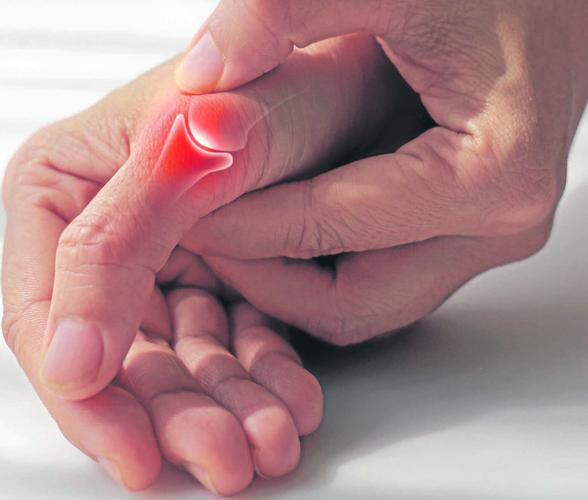
The thumb joint most likely to develop osteoarthritis is called the carpometacarpal, or CMC, joint. It’s at the base of the thumb, between the long bone in the meaty part of the thumb and a small bone in the wrist called the trapezium.
The CMC joint provides the thumb a large range of motion, including the ability to be opposable. This means it can move so it touches the tips of the other fingers, allowing the hand to hold and manipulate items. Ligaments (flexible bands of tissue that connect bones to other bones), tendons and muscles provide stability.
Arthritis in this joint, called basal thumb arthritis, is a problem of both degeneration and instability. As with osteoarthritis in any joint, the cushioning cartilage that covers the ends of the bones wears down. The supporting ligaments loosen, leading to instability.
“When this happens, the bones may no longer line up properly to function in a way that’s effective and not painful,” Caiati says.
Common symptoms
Symptoms of thumb arthritis include new or worsening pain at the base of the thumb and pain that extends into the hand or wrist on the thumb side. It can hurt when you pinch, twist or grab. A lateral pinch — bringing the thumb toward the side of the index finger — can be particularly painful. It also can hurt when you’re not moving it.
Some people are prone to dropping things because of pain, weak muscles or a misaligned joint that doesn’t send the right information to the brain about which muscles to engage to keep your hand around something.
Over time, the hand and thumb may develop visible changes that can affect range of motion:
- The base of the thumb may bulge outward, creating what’s called a shoulder sign.
- The space between the thumb and index finger may shrink, turning a wide V shape into a narrow angle.
- In severe cases, the thumb can take on a zigzag shape, known as a Z deformity.
How doctors diagnose thumb arthritis
To get a diagnosis, Caiati recommends seeing a hand surgeon. A primary care doctor or rheumatologist also can make the diagnosis. The diagnosis can be made with a physical examination and x-rays. The x-ray technician will place your hand in different positions for the x-rays to determine the amount of degeneration and degree of deformity.
The doctor may refer you to an occupational therapist specializing in hand therapy or — for a more severe case — may recommend surgery.
Treatment options
If arthritis is not too severe and you use joint protection techniques, there’s a good chance you’ll never need surgery. “We teach people how to use the thumb in ways that favor hand positions that provide stability and discourage ones that can cause instability,” Caiati says.
Therapy typically includes these elements:
Training in better mechanics: For instance, you’ll learn to avoid pinching with the thumb against the side of the index finger, which places stress on the joint. Keeping the hand in a rounded C shape while grasping and releasing items is gentler and more stable.
Hand therapy: Occupational therapists teach exercises to strengthen the small muscles that support the joint. These movements are targeted to stabilize the thumb. Here’s a simple example: pretend you are holding a tennis ball in your hand. squeeze gently and hold. repeat 10 to 20 times. This can help train the hand to keep the thumb in a stable position.
Splints and taping: There are both soft and rigid splints, along with special taping techniques. These can help stabilize the thumb and train the hand to use the most stable positions. you can get a custom-made splint or buy one over the counter; ask your occupational therapist for a recommendation to ensure you get the right kind.
Pain relief: Heat and self massage may help to relieve pain. Warmth tends to soothe aching joints more effectively than ice. Consult your doctor about the most appropriate pain medication. Many doctors will off er a corticosteroid injection for pain relief.
Hospitals face closure, despite rural health grants
Margery A. Beck and Ali Swenson
Associated Press
CREIGHTON, Neb. — Rick and Jane Saint John chose to live in the small town of Creighton, Nebraska, for one main reason: its hospital.
The couple has a child with nonverbal autism and epilepsy who requires up to three hospital visits a week. Creighton’s critical access hospital is a lifeline for Jane: not only is she employed there, but three years ago, doctors saved her life when she contracted bacterial pneumonia. If she waited another day for care, doctors said, her organs would have started to shut down.
“And if we had had to drive the hour to the Yankton (South Dakota) hospital,” Rick Saint John said, his voice breaking with emotion, “it could have cost her her life.”
So the Saint Johns were shocked to hear that Avera Creighton Hospital faces financial peril. A $50 billion government fund meant to transform rural health care will do little to help.
Hundreds of rural hospitals across the country face closure after years of funding problems. The issue was compounded last summer by the Trump administration’s massive cuts to Medicaid, the government’s safety net for low-income Americans, whose reimbursements long helped hospitals meet their bottom lines.
Outcry over the funding cuts prompted Republican lawmakers to create $50 billion in new rural health grants, but critics say that funding is intended for innovative health care delivery solutions — not propping up hospitals buckling under current pressures.
“It won’t pay to keep the lights on. And it won’t turn the lights back on once they’ve been turned off ,” said Dr. Ben Young, an infectious-disease specialist and policy expert with public health advocacy group Wellness Equity Alliance.
Republicans touted the $50 billion Rural Health Transformation Program in President Donald Trump’s tax-and-spending law last year as a way to help hospitals in rural areas.
Hospitals and health industry experts warned that while the fund — $10 billion per year allocated across all states for five years — offers some support to struggling rural hospitals, it won’t save them. The sum doesn’t come close to off setting the $137 billion rural hospitals expect to lose over the next decade, according to health research nonprofit KFF. Millions of people are expected to lose Medicaid benefits as a result of new Medicaid work requirements taking effect in 2027 — changes the Trump administration said will crack down on fraudsters rather than cut off eligible enrollees.
Administrators say the new $50 billion fund is not meant to shore up ailing rural hospitals or maintain the status quo, but transform rural health care through tech, workforce and other innovations. The White House said Wednesday the fund is intended to fund “big ideas” to improve rural health care access long-term.
“Decades of mismanagement by career politicians in Washington have left rural communities with limited care options,” White House spokesman Kush Desai said.
State applications show a wide range of proposals. Some pitches sought to improve emergency medical services and modernize rural facilities, while others looked to make school lunches healthier, expand physical fitness programs, beef up telehealth and expand artificial intelligence-driven technologies to help monitor patients.
Avera Creighton Hospital CEO Theresa Guenther argues her hospital is not in danger of closing but conceded that Medicaid cuts will be painful.
“Medicaid cuts will have an impact to us, and we — as well as many others — will have to figure out what that looks like moving forward,” she said. Her hospital hopes to get a piece of the $50 billion fund to help manage patients’ chronic diseases — like diabetes — and cover workforce costs.
Nebraska, which received $218 million for the rural health grants’ first installment, plans to spend some $90 million on healthier food options at schools, recruiting more health care workers and mobile sensors to remotely monitor chronically ill patients in rural areas, among other things. For rural critical access hospitals at risk of closing, it offers $10 million to “right size” them by getting rid of inpatient care, where bed occupancy typically is low.
Republican state Sen. Barry DeKay said hospitals like Creighton’s are vital, despite its low occupancy rate. The hospital is in his district; even his mother received life-extending care there after a hip replacement. He worries that the Medicaid cuts could hurt all the state’s rural hospitals.

Southwest Montana Health Care Directory