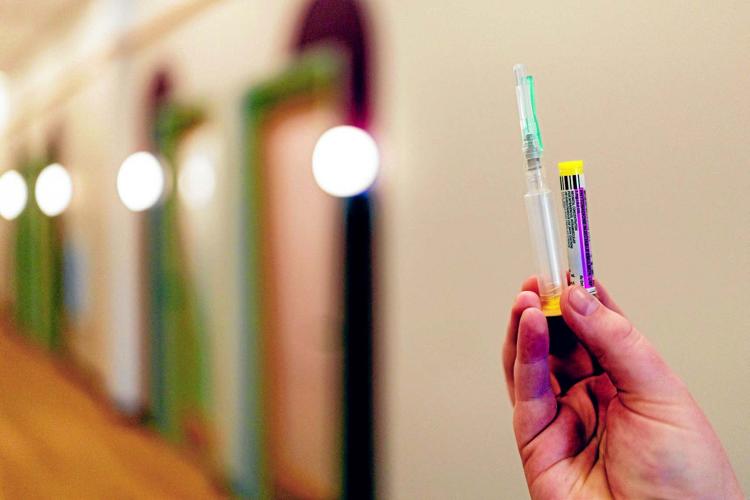


An illustration photo shows Phytonadione, a synthetic version of vitamin K, at a pediatric clinic in Ann Arbor, Michigan, Aug. 6.
Newborn vitamin K shot refusals spike
JULIE STEENHUYSEN
Reuters
CHICAGO — The percentage of parents and caregivers in the United States refusing a standard vitamin K shot for infants at birth has accelerated sharply this year, an exclusive data analysis for Reuters found, putting more newborns at risk of life-threatening bleeding episodes.
The data confirms what a dozen pediatricians, neonatologists and pediatric critical care specialists told Reuters is a top concern: rising refusals of a life-protective shot and a growing wave of mistrust toward vaccines and other newborn interventions.
For decades, Health Secretary Robert F. Kennedy Jr. has stoked that mistrust, sowing doubt about vaccines and other established medicines. The acceleration in vitamin K refusals this year aligns with his January announcement dropping recommendations for the birth dose of the hepatitis B vaccine, and five other standard childhood vaccines, from routine use.
The rate of newborns not receiving the vitamin K shot within a day of birth in hospitals jumped more than 57% from January through June, a review of health records for more than 1 million births nationwide by health data and analytics company Truveta revealed.
While vitamin K refusals have been on the rise for years, the Truveta analysis shows that in the first half of 2026, the rate of non-receipt was 2.5 times higher than the average rate from 2019 to 2024. It was 1.4 times higher than in 2025.
Babies are born with very low levels of vitamin K, which helps blood to clot, and are unprotected up until about six months of age, according to the Centers for Disease Control and Prevention, which still recommends the shot. Without the injection, they are 81 times more likely in those first six months to have life-threatening bleeding in the brain or gut, the CDC says.
One out of five infants who experience serious bleeding will die. Without the shot, such bleeding occurs in one out of 59 births.
“It’s really terrifying. It’s like we’re going backwards,” Dr. Nia Heard-Garris, pediatric physician scientist at Lurie Children’s Hospital, Chicago, said of growing refusals. “We’re trying really hard to keep little babies alive.”
Pediatricians like Heard-Garris are on the frontlines, caring for children as parents digest changes in U.S. health policy to align with Kennedy’s and President Donald Trump’s views, which are often at odds with the medical community.
When Kennedy dropped recommendations for the six childhood vaccines, he said American children got too many shots and suggested they were linked to chronic illness, for which there is no evidence.
Those changes are on hold due to a court ruling, but Trump called for them again in an Aug. 10 executive order. Experts say the mixed messages have raised doubts among many parents about routine newborn treatments, including vitamin K.
When asked about declining support for vitamin K relative to those policies in an April Congressional hearing, Kennedy denied any role.
U.S. Department of Health and Human Services spokesperson Grace Davis Jamison said the agency and the CDC are evaluating available data and surveillance related to vitamin K refusal and associated bleeding events. It continues to provide parents and healthcare providers with information about vitamin K, she said.
“Concerns about vitamin K and declining trust in public health institutions predate this administration and grew during the COVID-19 pandemic amid heavy-handed mandates during the Biden administration,” she said, adding that the agency is working to rebuild trust including through respect for individual choice.
The percentage of U.S. infants not receiving vitamin K at birth climbed to 8.1% at the end of June, from 5.2% six months earlier, according to the Truveta study, which reviewed health records from more than 140 million people. It identified 1,026,375 infants born to 825,599 mothers between January 2019 and June 2026.
Dr. Amanda Furr, chief medical officer of Zarminali Pediatrics, which operates 45 pediatric practices in 13 states, sees patients at a clinic in Rockville, Indiana, a town of 2,600 residents.
Vitamin K refusals in hospitals have become so common that Zarminali has started stocking the shot in all primary care practices, Furr said. Two other doctors told Reuters they were also now providing the shots.
When Dr. Sarah Coggins was a medical student at Vanderbilt Children’s Hospital in 2013, Nashville experienced an unusual cluster of babies with severe bleeding from vitamin K deficiency.
Their parents believed the shot was unnecessary, and potentially toxic or carcinogenic, according to an account published by the CDC. Coggins cared for one of these infants.
“The baby had long-term brain damage,” said Coggins, now a neonatologist with Children’s Hospital of Philadelphia. “I’ve always carried that with me. I think most pediatricians have a story like that.”
Vitamin K refusals soon began to rise, a previous nationwide study showed.
Coggins is fighting mistrust of the shot in her own practice, which requires parents who refuse to sign a form saying they understand the risks.
She and others have noticed a difference, however, in parents who oppose the shots but want their boy babies circumcised. Many hospitals prohibit circumcision in boys who have not received vitamin K because of the bleeding risk of such procedures.
Coggins and colleagues studied medical records at three hospitals affiliated with the University of Pennsylvania health system in Philadelphia and found being born a girl was associated with twice the risk of vitamin K refusal.
Truveta’s national analysis confirms that finding, showing that baby girls are disproportionately impacted by the rising rates of vitamin K refusals. In June of 2026, 8.9% of girls and 7.3% of boys had not received the shot within a day of birth.
That raises the question of whether vitamin K deficiency — and bleeding events — will start to affect more girl babies.
“It’s not a theoretical risk. It keeps me up at night,” said Coggins, who is working with colleagues to design a study to answer that question.
Doula care still out of reach for many
Medicaid participation limited by paperwork, expenses
RACHEL SPEARS
KFF Health News
Doula Taja Iglesias and her business partner have built a space in Alexandria, Virginia, that’s all things pregnancy, birth and childcare.
Comfortable couches in one area invite expectant parents to settle in for birth education classes. In another, a colorful pile of toys await the babies and toddlers. And there’s a free supply of diapers and food. Years ago, as Iglesias was giving birth and expressing her wish not to have an epidural for pain, she felt isolated and that her preferences were dismissed by the medical staff. Today, she works hard to make sure other parents can have the support of a doula.
“We kind of created this to fill the gaps that we realized existed because we had to go through it,” said Iglesias, founder of The Momager Co., a doula agency dedicated to giving parents care throughout the perinatal process.
Iglesias said one of the widest gaps is the lack of access to doula care for parents on Medicaid.
Doula care has been associated with improved breastfeeding initiation and less maternal anxiety. Perinatal doula care covers education about pregnancy and birth, advocacy for new parents in the hospital, and help with lactation and recovery after delivery. Doulas often work alongside doctors or midwives who provide medical care.
“The doula is the person that already knows what you want. We know what your dream birth is,” Iglesias explained. “We’re somebody that is standing on the side of the parent.”
In 2022, Virginia became the fourth state to start reimbursing doulas through Medicaid. A push to address the country’s maternal mortality rates, which are higher than in other high-income countries, has been an engine for lawmakers looking to give women on Medicaid the support of doula care. For example, another Virginia law requires hospitals to allow an extra person, other than a family member, in the delivery room.
The services offered and the number of visits covered by Medicaid vary by state, but today doulas are covered in 26 states and Washington, D.C. An additional 20 states have considered proposals or are working to implement similar policies.
In Virginia, doulas say the administrative and logistical challenges they encounter are trickling down to moms. A review of the Virginia Certification Board’s Doula Registry in June found that just 19 doulas based in Northern Virginia accept payment from Medicaid.
Doulas say while Medicaid coverage of their services is a good first step, the amount of paperwork required in the approval process and the low reimbursement rates mean fewer doulas participate in the Medicaid program, reducing access for beneficiaries.
A 2021 law that extended doula benefits to Medicaid enrollees sought to improve the health of Virginia parents and decrease the number of mothers who die during the time surrounding birth. The state’s maternal mortality rate is among the nation’s highest.
To access doula services in Virginia, parents on Medicaid must have a referral from a doctor, and their doula must be approved by the state to care for Medicaid beneficiaries. Iglesias would like to see that process be quicker and less costly for doulas, who pay $75- $150 for certification.
While the policy debates continue, Iglesias has decided not to get certified to care for parents on Medicaid. Instead, she raises money to provide doula care for parents on Medicaid outside the system.
“I don’t want to be state-certified with a training that I feel is not full and complete, a training that doesn’t touch on that community aspect of work,” she said.
Iglesias said the services covered are too limited and Medicaid does not allow her to work with clients as she sees fit. Virginia’s payment covers up to eight doula visits. All but the first visit are limited to one hour, which Iglesias said isn’t enough time.
While pursuing her Ph.D. at George Mason University, Desirae Leaphart Mensah studied the initial implementation of the doula reimbursement policy in Virginia.
She collected data from 2022-24 for a study published this year, and interviewed doulas eager to serve clients on Medicaid. But some told her they got bogged down in the paperwork and never were certified.
Mensah said the mismatch between the size of the Medicaid population and the low number of doulas available leads to fewer parents receiving doula care.
Coverage is a good first step, Mensah noted, but it doesn’t translate to enough access. During the first two years of implementation, fewer than 1% of Medicaid births in Virginia used doula services.
Kenda Denia, executive director of Birth in Color, a statewide doula collective in Virginia, welcomed the law at first.
“But now we’re looking at certain logistics that are not working,” she said.
Private-pay doulas in Virginia commonly charge $1,200 to $3,000 per pregnancy. For families wanting more extensive prenatal or postpartum services, the fee can be as much as $6,000. Virginia’s Medicaid program reimburses doulas $859 per pregnancy. They receive an additional $100 if their client attends prenatal and postpartum doctors’ visits.
The pay is too low and does not reflect the value of the services they provide, Denia said.
“Midwives don’t get paid this. Doctors don’t get paid this,” she explained. “We are driving to people’s homes for postpartum and prenatal care.”

Southwest Montana Health Care Directory