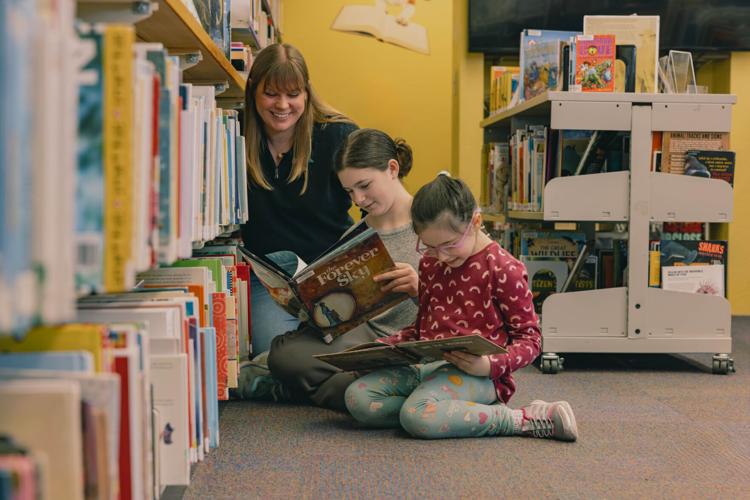


March marks the kick-off to National Reading Month, a celebration that encourages families and communities to create a daily habit of reading.
This March, Montana’s libraries are celebrating National Reading Month by doing what they do best: continuing to offer free, easy-to-access resources to every Montanan in the state.
Providing that type of access to free resources is no small feat in a state that’s as large and rural as Montana. According to data from the Montana State Library, in 2025, Montanans borrowed more than 6.2 million books and other items from the more than 750 libraries in almost every corner of the state.
Of those, 1.9 million checkouts came from libraries that have formed sharing groups to expand the number of titles they’re able to offer to patrons. Pooling resources is a critical way Montana libraries are doing more with less, working together to move books and physical items to where they’re needed instead of buying duplicates.
The books travel by courier in crates to 55 participating libraries, and volunteers and staff pick up “last-mile” delivery for the rest. In 2025, 302 tons of crates traversed the state via the Montana Courier Program to Montanans awaiting their requested books.
“If we don’t have it, we will find it,” said Sarah Peterson, director of the Miles City Public Library. “It works so well. It’s so cool. Let’s say you live in Terry, and you can’t always get to the library in Glendive or Miles City, but you want to read, or you want to learn, or you want a DVD, or you want — something — we can get it for you. And that’s access.”
In fact, in Terry, population 562, there are 440 library cardholders. Last year, they borrowed 1,083 books through the sharing groups.
Of course, books, audio books, DVDs, music and laptops aren’t the only things libraries offer. Programs, events, classes and free community meeting spaces are critical to the unique culture of each library. In 2025, Montanans of all ages attended 358,000 educational library programs, with more than 120,000 children and caregivers attending 6,300 early literacy programs.
Even the buildings themselves offer a reflection of the community each library serves.
Aaron LaFromboise, library director at Blackfeet Community College, has designed the space to be responsive to the Browning community. LaFromboise moved the bookshelves to line the walls of the library and created a flexible seating space in the center that can be rearranged to accommodate different activities.
“It’s very intentional, because our traditional learning is oral and experiential, and so I want to be able to perpetuate that, without putting such an emphasis on the written word. That’s important,” Aaron said. “I love when people want to learn through books, and I’m here to help them. But I also know that is not necessarily the way my community learns.”
Even though libraries offer hundreds of thousands of informational and educational items, librarians themselves are perhaps the best resource of all. On any given day, a librarian in Montana might get asked hundreds of questions — anything from a general request for information, to public meeting room reservation help, a notary request, resume guidance, help with checking out an early literacy kit — and more. In 2025, Montanans asked their trusted librarians an estimated 602,000 questions.
Tony Edmundson, public services librarian at the Flathead County Library, chose to put his desk in the middle of the library floor to encourage patrons to ask him for help.
“Customer service is a lot of microtransactions — somebody’s looking for a product,” Tony said. “It might be they need to print, they need to get a book, or they need a form, and they have no idea how to get it. That’s looking at it minute by minute, hour by hour. But customer service, the longer you go, the more the story becomes about community and about a special spot that we have in the community as a vital resource.”
This March, celebrate National Reading Month by making a habit of visiting your library!
Learn more at montanansforlibraries.org.