


Story and photos by Lisa Hornstein of the Montana Standard
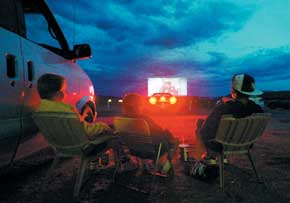
As the summer sun sinks behind the craggy peaks of the Anaconda Range in the west, movie-goers begin to take their places at the Silver Bow Drive-In.
Vehicles slowly find parking spots, lawn chairs spring up around the grounds, the aroma of popcorn fills the air, kids frolic amidst the cars, and the show begins. Since 1977, the Silver Bow Drive-in, southwest of Butte, has provided outdoor movie-going
experiences for area residents.
It started in 1950 as a single screen drive-in theater in Deer Lodge, but the operation moved to the rural Butte location in 1977. Three years later, in 1980, a second screen — this one facing north — was added. Six drive-ins operate in Montana. However, Butte's is the only theater with twin screens.
People are also reading…
The Silver Bow Drive-in is a family affair run throughout the summer by Mark and Holly Hansen. Their
22-year-old son, Jens Hansen, a student at Montana Tech, has pitched in "for as long as I can remember," he said. As a kid, Jens and his younger sister would tote a sign and bucket, and walk through the rows of cars washing windshields for 25 cents a shot. With the proceeds, Jens bought his first mountain bike. Jens now mans the ticket booth.
Running a drive-in is a continuous maintenance project, said Mark.
"It's not just come flip a switch and yeah there's a movie," he said.
The job is 8 p.m. to midnight every day of the week during summer and each weekend in spring and fall.
"While everybody else goes camping, you run (the theater) every night," Mark said.
Movie theater operation goes way back in the Hansen family. His father owned numerous theaters, including those in Boulder, Whitehall and Deer Lodge.
"They've always been doing it; it's in their blood," Holly said.
In fact, the movie theater played a major role in Mark and Holly's future. They were just 20 when they met at a theater in Butte — he was a projection boy and she worked in concessions. They have been together since.
Drive-in theaters attract all kinds of movie-goers — families and children, teen-agers and couples. People interviewed for this story said they like the freedom of personal choice the drive-in provides. For example, on one particular night in August, a family of three from Twin Bridges cozied up in the back of their pickup truck to watch the show.
"It's like being in your living room, but outside," Lisa Hamilton said.
On another occasion, a group "brought a small hot tub on a trailer," Holly said.
Children have freedom to roam at the drive-in — unlike the closed quarters and aisles of a theater building. Parents like that.
"You can bring the kids and not worry about bothering anyone else," said Amanda Bohrer of Deer Lodge. "Kids never last through a movie so they can sleep in the car."
Not much deters Mark Hansen from keeping the projectors going. In late August 1992, six inches of snow blanketed the Butte area. Hansen was undaunted.
"You could see the picture in the snow," he said.
According to the Associated Press, drive-ins were once on the brink of extinction, but have managed to survive. To the credit of devoted fans who keep buying tickets and of business-savvy owners who found other sources of profit, the two have kept drive-in theaters thriving.
In fact, the number of drive-ins has held steady at about 500 for the past 10 years, said Don Sanders, author of "The American Drive-in Theater." While it's nowhere near the peak of 5,000 in 1958, there's no sign that the drive-in will fade to black.
Invented in 1933 by Richard Hollingshead in Camden, N.J., the drive-in was a marketing scheme intended to lure customers to the gas station at night, Sanders told the Associated Press.
Soon, giant screens, murals, neon lights and in-car speakers followed the post-World War II boom. Families became the drive-in's main staple in the 1950s until teens gave it a new reputation as "the passion pit" in the 1960s.
For a variety of reasons, including competition from television and later VCRs, the drive-in began to droop from the late 1960s on. Some owners even blamed customer decline on the adoption of daylight-saving time in 1967, arguing that families didn't want to stay out late.
Land value and ever-expanding cities forced many drive-ins to sell in the 1980s, making many believe that the very American institution would be lost.
Hansen is unsure how many more years he'll keep the Butte drive-in operating.
"My kids have no interest, and I hope they do something else," he said, and credited Holly as the person who keeps everything running.
"All I do all summer is look forward to bird hunting," he said.
Lisa Hornstein is a senior at the University of Montana, Missoula. She spent the summer as a photography intern at The Montana Standard. This piece is one of many she did throughout her internship in Butte.


