


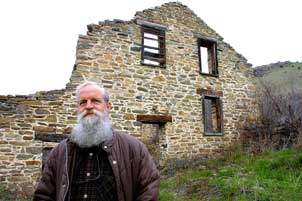
PONY — In 1867, a miner tired of the competition in nearby Alder Gulch struck out on his own in the Tobacco Root mountain range. Tecumseh "Pony" Smith found a bit of color in those hills and returned a year later with a friend. Their placer operation attracted attention from other miners, and a mining camp called Pony Gulch soon grew. Like most placer operations, it didn't last long and the miners drifted away.
Another enterprising miner named George Moreland discovered a rich, hardrock deposit in nearby Pony Creek. The discovery brought in more people, and by 1877 the town of Pony was up and running. It included a hotel, saloon, livery stable, store and shoe shop as more miners arrived to work the abundant ore bodies in what was to become the Mineral Hill mining district.
Like many of Montana's early mining communities, its heyday proved to be short. By 1887 the census recorded 87 residents. People drifted away, leaving many of the historic buildings behind.
People are also reading…
That history comes alive in a book recently published by The Pony Homecoming Club called "Pony, Montana: A Golden Past, Still a Treasure." Filled with historical accounts of the town's beginnings and illustrated with a collection of photographs both historic and recent, the book gives people an opportunity to learn a bit about Montana's colorful
history.
The effort to produce a book about Pony's historical buildings originates in Homecoming Club's Pony Survey Project that began in the mid-1980s. More than 2,000 hours were spent sifting through information to produce a narrative of Pony's historic buildings. That first effort resulted in a book that was basically the collection of forms from the architectural surveys completed during that initial effort.
From that, the chairman of the Pony Homecoming Committee, David Zimmerman, went to work on the latest edition, which was published recently. Zimmerman used digital technology to upgrade present day photos and added historical photographs. He also worked to condense the information into something that is more readable.
"There are a lot of buildings here and a lot of history," Zimmerman said. "At one time there was a pretty big fire that took out about half the town, and some of the rest has been carted away; but there's still a good core of buildings."
"The local lore claims that there were up to 10,000 people here at one time. I think it was probably closer to 1,000 during it heyday. That's about 10 times of what it is now."
"There was about a
20-year period when it was really cooking. Somewhere between 1880 and 1900," Zimmerman said.
Zimmerman learned a lot about his home of nearly a quarter-century while working on the book.
"There are a lot of people who love this town," he said. "You do get assorted versions of its history from different people. You have to try and sort out what's the most accurate."
For instance, there are people who believe that the residents of Pony had electricity before those living in New York City.
"That really doesn't appear to hold water," Zimmerman said. "It looks like there was electricity here for industrial power and eventually they did run a line down to the town so people there could have power for a couple of hours a day."
Even after most of the mining slowed, people moved to find work elsewhere, yet some stayed behind intent to make Pony their home. In the 1950s, when the Pony School was closed and townspeople worried it would fall into disrepair, they chose to create the Pony Homecoming Club.
From that beginning, the residents with the occasional help from those who'd moved away, began working to save history. A couple of years ago, the club was given the Pony White Church building, which it now operates and maintains. The club also maintains the town park.
"It's a pretty full plate for us," said Zimmerman.
The club has 150 paid members, of which "a core group does most of the work and takes most of the heat."
Maintenance on the school and church buildings is a "major deal. We've raised and spent probably $30,000 on the two buildings."
Plans are to install a new heating system in the gymnasium and install a bathroom so it can be used in winter, Zimmerman said.


